Fleur de Sel
Last updated: 22 Jan 2026
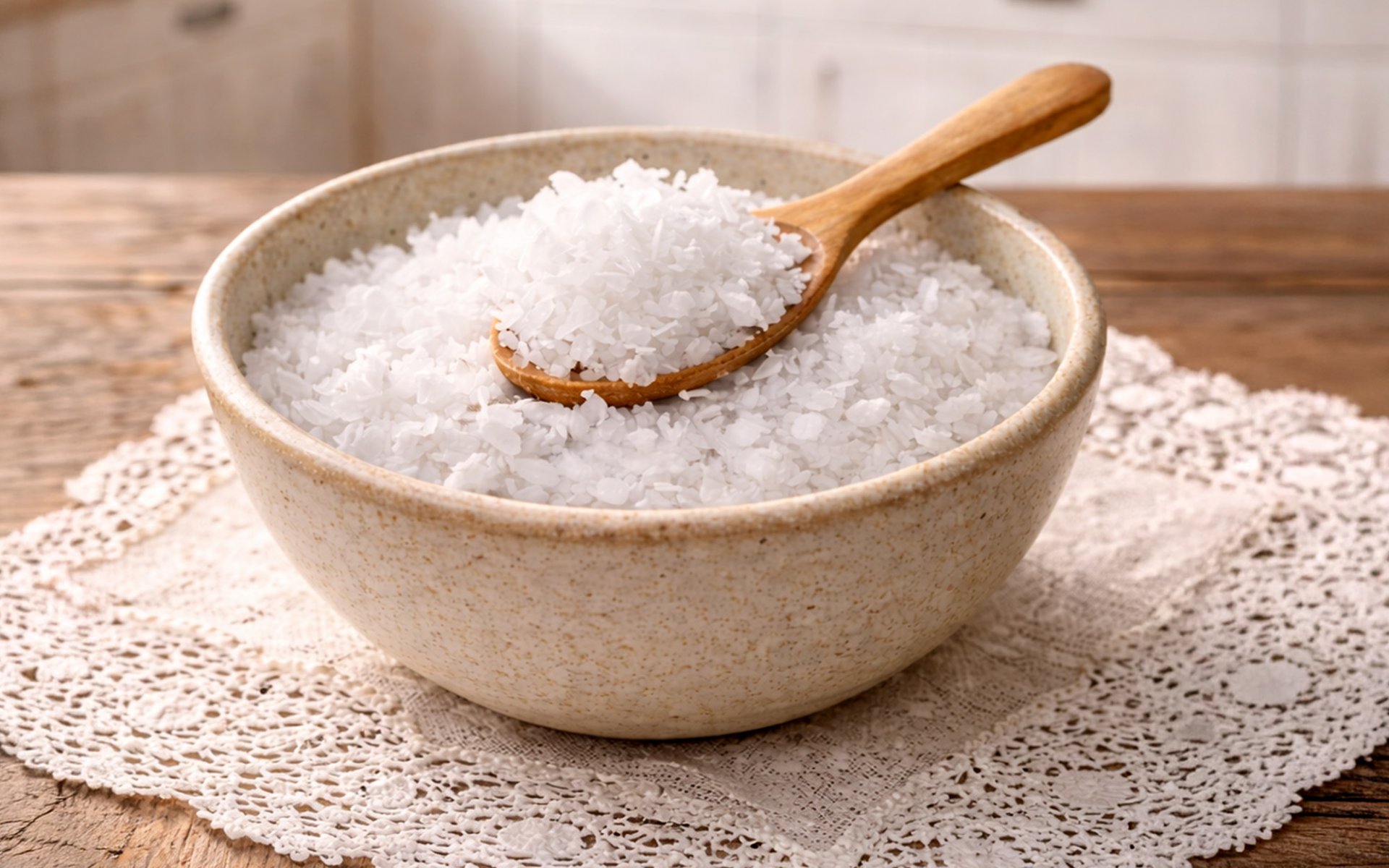
Fleur de Sel is a special type of sea salt widely regarded as one of the most precious and rare salts in the world. With a history dating back to ancient times, it continues to be harvested using traditional methods that rely strictly on human skill and the delicate rhythm of nature—a practice that has endured to this day.
It is also widely used in select desserts, such as salted caramel and premium chocolates. In these applications, Fleur de Sel’s gentle, nuanced salinity cuts through sweetness, adds balance, and introduces a refined layer of complexity to the flavor experience.
The Meaning and Origin of the Name Fleur de Sel
The term Fleur de Sel comes from French and literally means “flower of salt.” This name reflects the salt’s distinctive appearance: thin, delicate white crystals that resemble flower petals. These fragile crystals form only under precise weather conditions, when sunlight, wind, and humidity are perfectly balanced.Fleur de Sel in Ancient Roman History
The harvesting of Fleur de Sel can be traced back to antiquity. Pliny the Elder, the Roman historian and naturalist, recorded in his work Natural History that the Romans were familiar with this salt under the name “Flos salis.” At the time, however, Fleur de Sel was not widely used as a culinary seasoning; instead, it was primarily applied for medicinal purposes, such as a laxative or a topical treatment for wounds.The Historical Significance of Guérande, France
Although its use dates back to ancient Rome, the most significant chapter in the history of Fleur de Sel began in Guérande, in the region of Brittany (Bretagne), France. Historical records indicate that in 945 CE, monks from Landévennec Abbey studied the coastal environment—observing tidal movements, wind patterns, and the influence of sunlight—before developing a salt-harvesting system powered entirely by natural forces. Remarkably, this system remains in use today.The Creation of Traditional Salt Marshes
These monks established salt marshes along the Guérande coast, designing them as an open-air “factory” that relies on seawater, wind, and sunlight as the core elements of production. The system proved highly successful, enabling Guérande’s salt marshes to produce salt continuously for many centuries.Salt as “White Gold” in the Middle Ages
During the Middle Ages, salt was an extremely valuable commodity, often referred to as “white gold,” due to its vital role in food preservation and daily life. As a result, Guérande rose to prominence as one of Europe’s most important salt-trading centers.Early European Salt Trade Routes
The salt production system in this region helped establish some of Europe’s earliest salt trade routes, bringing sustained prosperity and wealth to Guérande for centuries. Guérande salt was so valuable that it was sometimes used as a form of currency and as a trade commodity across different regions of Europe.Defensive Fortifications of Guérande
Because of the economic and strategic importance of salt, Guérande constructed strong walls and fortifications to defend the city—particularly after it was attacked by Spanish forces in the 14th century.The Traditional Harvesting Process
The harvesting of Fleur de Sel begins with the construction of embankments and dikes that channel seawater into shallow salt pans. The water is then left to evaporate naturally through the combined effects of sunlight and wind.The Role of the Vasière Basin
The salt marsh system consists of a series of interconnected shallow basins that rely on the natural rhythm of tides. Seawater, with an initial salinity of approximately 25 grams per liter, first enters a settling basin known as the vasière, where sediment settles and the water becomes clean and suitable for evaporation.The œillets and Salt Crystallization
As the water gradually flows through subsequent basins, its salt concentration steadily increases. Eventually, it reaches the final shallow pools called œillets, which are only a few centimeters deep. At this stage, salinity rises to around 250–280 grams per liter, causing salt to begin crystallizing.Formation of Fleur de Sel on the Water’s Surface
Under ideal weather conditions—appropriate temperature, sunlight, and wind direction—fine salt crystals slowly form on the surface of the water as a thin, delicate layer resembling flower petals or snowflakes. These crystals are Fleur de Sel. However, they are extremely fragile; even slight disturbances of the water surface, caused by wind or a bird flying overhead, can cause them to sink. Once they fall to the bottom and come into contact with the clay floor, they become Sel Gris, or grey salt, which has a distinctly different texture and character.Traditional Tools Used for Harvesting
To harvest Fleur de Sel, workers use a special wooden rake called a “lousse à fleur,” gently skimming the crystals from the water’s surface to preserve their delicate structure.The Role of Women in Traditional Harvesting
Historically, the harvesting of Fleur de Sel was often carried out by women, based on the belief that the fragile crystals required exceptional delicacy, patience, and gentle movement. After harvesting, the salt is placed in special containers and left to dry naturally under the sun before being carefully stored and packaged. Throughout the process, handling is kept to a minimum to preserve the crystals’ shape and quality.Why Fleur de Sel Is Rare and Valuable
Because Fleur de Sel relies entirely on specific natural conditions, skilled manual labor, and specialized expertise, its yield is limited. This rarity is what elevates Fleur de Sel above ordinary sea salt.Characteristics and Flavor Profile
Fleur de Sel is not pure white like refined salt; instead, it typically appears pale gray or off-white due to the natural presence of clay from the salt marsh floor. In some regions, Fleur de Sel may display a faint pink hue, resulting from the presence of Dunaliella salina—a pink microalga commonly found in salt marsh ecosystems and an integral part of natural salt production.Mineral Composition and Taste of the Sea
Fleur de Sel contains a variety of natural minerals, including calcium and magnesium chloride, which contribute to its complex flavor profile. These minerals give Fleur de Sel a clean yet gentle salinity—distinctly salty without being harsh—often described as delivering a true “taste of the sea.”Regional Variations in Flavor
The mineral composition varies depending on the harvesting location, giving Fleur de Sel from different regions subtle differences in flavor. This natural variation is considered one of its most distinctive and appealing qualities.IGP Certification of Guérande Salt
Salt from Guérande has been awarded IGP (Indication Géographique Protégée) status, a protected geographical indication that officially guarantees its origin, traditional production methods, and time-honored harvesting techniques.Culinary Uses
Today, Fleur de Sel is highly prized by professional chefs worldwide and is regarded as one of the finest finishing salts available. Its complex flavor, delicate texture, and ability to enhance dishes without overpowering the natural taste of ingredients make it exceptionally versatile.Using Fleur de Sel with Savory Dishes
Fleur de Sel is ideal for a wide range of dishes, including steaks, seafood, and salads. Because its crystals are thin, light, and slow to dissolve on the tongue, sprinkling it just before serving enhances the primary ingredients, adding clarity, depth, and dimension to the overall flavor.It is also widely used in select desserts, such as salted caramel and premium chocolates. In these applications, Fleur de Sel’s gentle, nuanced salinity cuts through sweetness, adds balance, and introduces a refined layer of complexity to the flavor experience.
Tags :
Related Content