Moules Frites
The Origins : From Ancient Coasts to the "Bouchot" Method
Long before mussels earned their place as a premium ingredient in Belgian and French restaurants, they had served as a staple food for coastal communities for thousands of years. Easy to harvest, highly nutritious, and inexpensive, mussels provided an important source of protein for people living along the North Sea coast since ancient times.Archaeological evidence indicates that coastal populations in Western Europe, particularly the Celts and the Romans, harvested mussels from rocky shores and intertidal zones long before the Common Era. During the Roman Empire, mussel consumption became even more widespread throughout the territories that are now Belgium, the Netherlands, and northern France, where nutrient-rich coastlines created ideal natural habitats for mussels to thrive.
A significant turning point came during the 13th century with the development of the Bouchot method of mussel farming along France's western coast. According to legend, Patrick Walton, an Irish sailor who survived a shipwreck, drove wooden stakes into the sea to support bird-catching nets. He later discovered that mussels had attached themselves to the submerged poles, leading to the development of an innovative cultivation technique. This method allowed mussels to grow more efficiently, protected them from predators living on the seabed, and produced more consistent harvests. Although many historians regard the story as folklore, the Bouchot system is widely recognized as one of Europe's oldest mussel-farming techniques and remains in use today.
Although Belgium has its own North Sea coastline, most of the mussels consumed in the country are sourced from aquaculture farms in Zeeland, a province in the Netherlands. Located within the nutrient-rich Rhine-Meuse-Scheldt river delta, Zeeland offers ideal tidal conditions for producing high-quality mussels. Its close proximity to Belgium allows freshly harvested mussels to be transported quickly to markets and restaurants, making them the primary ingredient of Moules Frites and an integral part of Belgian culinary culture.
The Great Debate: Belgian Frites vs. French Fries
Another essential component that transformed Moules Frites into Belgium's national dish is Frites, or Belgian fries. While people around the world commonly know them as French fries, Belgium has long claimed to be their true birthplace, and this remains one of the most enduring culinary debates between Belgium and France.According to a widely repeated legend, villagers living along the Meuse River Valley traditionally caught and fried small freshwater fish as early as the late 17th century. During harsh winters, however, the river often froze, making fishing impossible. To replace the unavailable fish, the villagers cut potatoes into long strips resembling small fish and fried them in beef fat. This practice is believed to mark the origin of French fries around 1680. Many food historians, however, question this, pointing out that potatoes had not yet become widely cultivated in the region during that period.
The name "French fries," now recognized around the world, is believed to have originated during World War I. American soldiers stationed in Belgium reportedly tasted fried potatoes there for the first time. Because French was the primary language spoken within the Belgian Army, the soldiers mistakenly assumed the dish was French and began referring to it as French fries.
The Secret to Authentic Belgian Frites: What distinguishes authentic Belgian Frites from ordinary fries is the double-frying technique. The potatoes are first fried at a relatively low temperature until cooked through, then allowed to rest before being fried a second time at a higher temperature. This process creates a crisp, golden exterior while preserving a soft and fluffy interior.
Traditionally, the fries were cooked in beef fat, which imparted a richer aroma and deeper flavor. Although many modern restaurants now use vegetable oil, numerous traditional Belgian friteries continue to follow the classic method.
The Culinary Marriage : When Mussels Met Fries
Although mussels and fries each have long and distinguished histories, their combination as Moules Frites did not emerge until the 19th century, coinciding with the expansion of restaurants and the growing culture of dining out in Belgium's major cities.One of the most widely cited accounts credits Maison Fritz, a restaurant in Liège, as the first establishment to officially serve Moules Frites in 1875. This marked an important milestone, bringing together two ingredients that had traditionally been eaten separately into a single signature dish.
However, some food historians believe that the dish may have originated even earlier in the city of Ghent and the major port towns of Flanders, where street vendors were already serving mussels alongside fried potatoes to laborers by the mid-19th century.
What most historians do agree on is that the popularity of Moules Frites stems from the perfect harmony between its two main ingredients. Mussels were abundant and inexpensive, while potatoes were a reliable agricultural crop. Another widely accepted theory suggests that during the winter months, when freshwater fish became scarce due to frozen rivers, fries naturally took their place as the preferred accompaniment to North Sea mussels.
4 Classic Regional Variations of Moules Frites
Over time, Moules Frites has evolved into numerous regional variations. While the essential pairing of mussels and fries has remained unchanged, the broth used to steam the mussels has been adapted to suit regional tastes:
Moules Marinière : The most traditional and widely recognized version. Mussels are steamed with white wine, shallots, butter, and fresh parsley, creating a light, fragrant broth that beautifully enhances the natural sweetness of the shellfish.
Moules à la Crème : A richer variation of the classic Marinière that incorporates fresh cream into the broth, producing a smoother, luxurious flavor. The remaining creamy broth is often enjoyed as a dipping sauce for the fries.
Moules à la Bière : Subbing white wine for Belgian beer (such as Witbier, Blonde Ale, or other malt- and hop-forward beers) adds additional layers of aroma and complexity to the broth.
Moules à l'Ail : Perfect for garlic lovers, this variation features a generous amount of chopped garlic sautéed in butter before the mussels are steamed, resulting in a deeply aromatic, savory broth.
How to Eat Moules Frites Like a Local
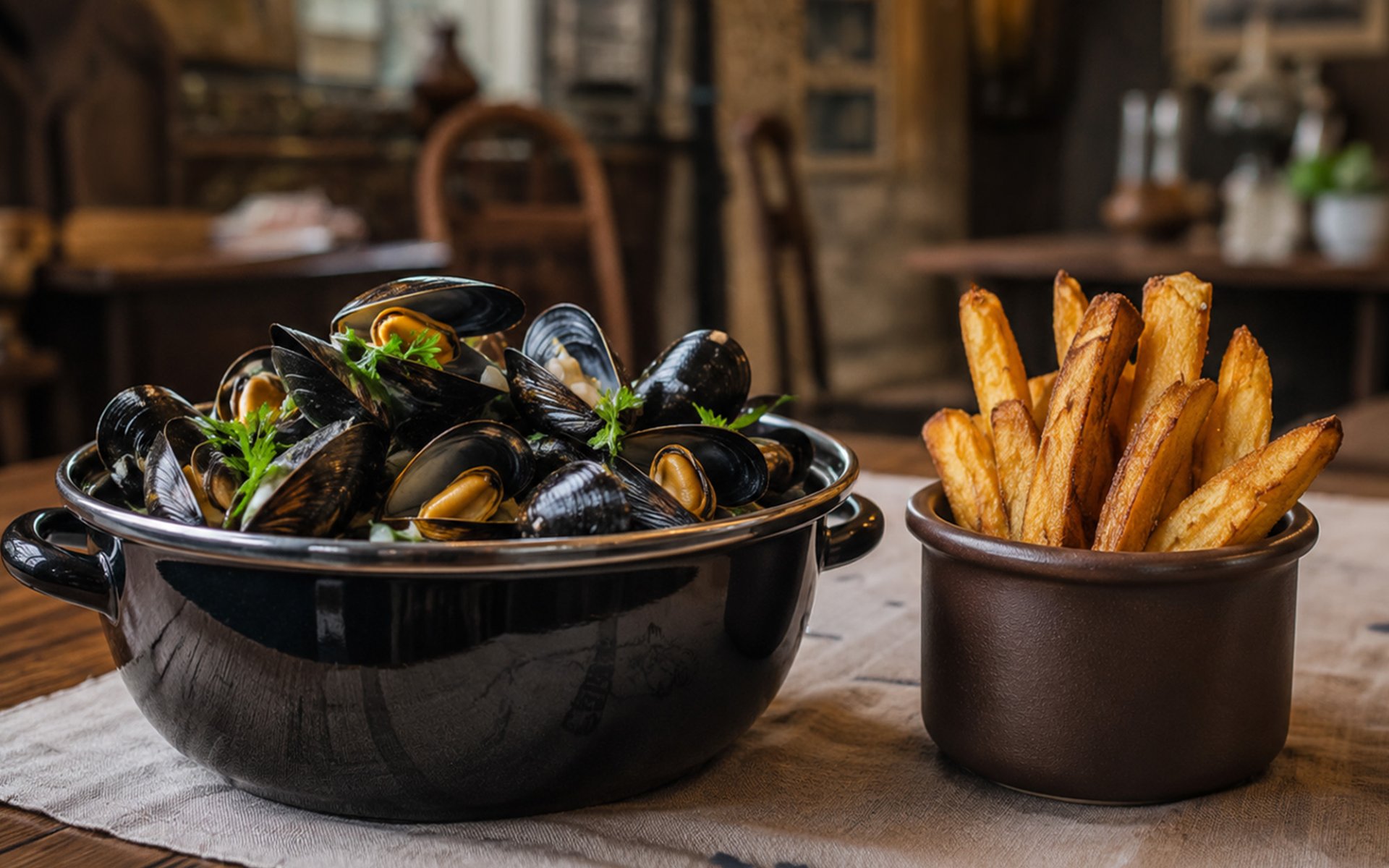
Belgians and the French also have a distinctive way of eating Moules Frites. Rather than using a fork to remove each mussel from its shell, diners traditionally use the first empty mussel shell as a pair of natural tongs to pick the remaining mussels from their shells. The fries are always served separately, either in a bowl or a paper cone, preventing them from absorbing moisture from the broth and ensuring they remain perfectly crisp throughout the meal.
An Enduring Cultural Icon
Today, Moules Frites is widely recognized as one of Belgium's national dishes. Each year, Belgians consume tens of thousands of tons of mussels, making it deeply embedded in the country's everyday life, particularly during the mussel season from late summer through early spring.
Many historic restaurants in the Brussels-Capital Region, especially those along Rue des Bouchers—the city's famous historic gastronomic street—continue to prepare Moules Frites according to time-honored traditions, ensuring that it remains one of Belgium's most treasured gastronomic traditions on the global stage.