Bruschetta
Last updated: 3 Aug 2026
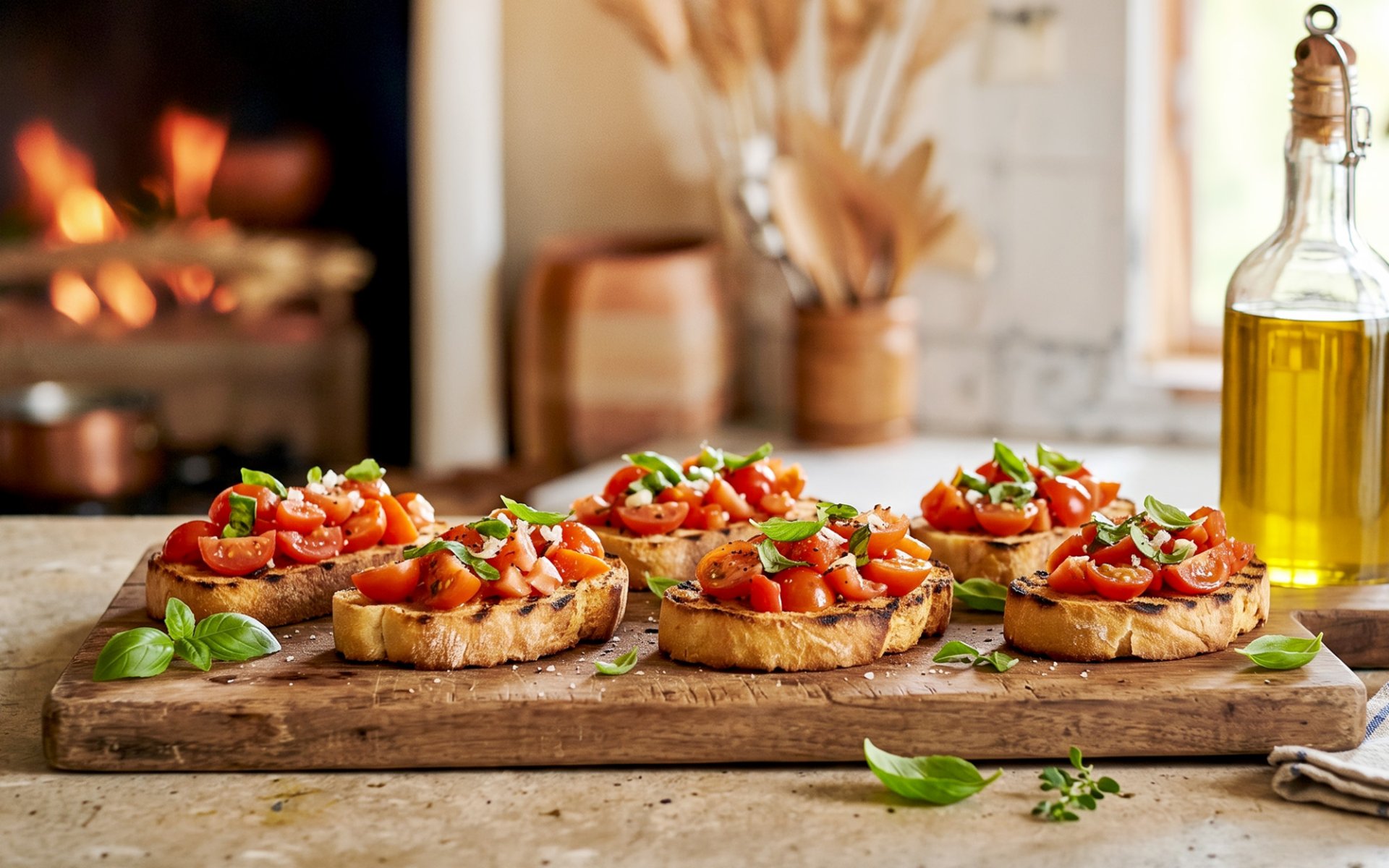
Bruschetta is a traditional Italian appetizer celebrated for its simplicity and its emphasis on high-quality ingredients. At the heart of this dish is rustic bread, grilled until the surface becomes crisp and aromatic, then rubbed with fresh garlic while still warm to allow the fragrance to permeate the bread. It is finished with a generous drizzle of Extra Virgin Olive Oil, creating a dish that represents the essence of Italian culinary philosophy: transforming humble ingredients into something extraordinary.
The name “Bruschetta” originates from the Romanesco dialect verb “Bruscare”, meaning “to roast over coals” or “to char.” The term is closely related to the Italian word “Abbrustolire,” which refers to the process of grilling or toasting bread until its exterior becomes crisp while developing a distinctive smoky aroma from the fire.
Across Italy, Bruschetta is known by different names depending on regional traditions. In Tuscany, it is traditionally called “Fettunta,” meaning “a slice of bread soaked with olive oil,” while in Piedmont, it is known as “Soma d’aj,” which translates as “bread with garlic.” These regional variations reflect the diverse culinary identities of Italy, where local ingredients and customs have shaped different interpretations of the same fundamental dish.
Marcella Hazan suggested that the history of Bruschetta is almost as old as the history of olive oil itself. In ancient times, one of the simplest ways to appreciate freshly pressed olive oil was to pour it over warm toasted bread, sometimes enhanced with a touch of fresh garlic to add aroma and depth of flavor. This simple practice allowed people to directly experience the freshness, fragrance, and quality of newly produced olive oil.
According to Waverley Root’s writings, the Romans had similar foods known as “Clustrum” or “Crustulum.” Archaeological evidence from the ancient settlement of Cures, the homeland of the Sabines, mentions the distribution of Clustrum together with Mulsum, a type of honey-sweetened wine, during Saturnalia, one of the most important festivals of Ancient Rome. This evidence suggests that toasted bread served with olive oil was not merely a food for farmers or laborers, but also had a role in Roman celebrations and social gatherings.
During the Roman era, olive cultivation and olive oil production were fundamental parts of Mediterranean life. When the olive harvest season arrived and freshly extracted oil was produced, farmers needed a simple yet effective way to evaluate its quality. The traditional method was to grill bread over an open fire, rub it with fresh garlic, and drizzle it with newly pressed olive oil. Through this process, they could assess the oil’s aroma, flavor, freshness, and overall quality directly.
At that time, bread was often made from whole grains and baked in communal ovens only once a week, or sometimes even once a month in rural areas. As a result, bread quickly became dry and hard after baking. To make it enjoyable again, people developed the practice of grilling stale bread over charcoal, rubbing it with garlic grown in their home gardens, and finishing it with olive oil and a sprinkle of salt.
The heat from grilling restored the bread’s crisp texture and enhanced its aroma, while olive oil provided moisture and richness. Through this simple technique, an ordinary piece of old bread could be transformed into a flavorful and satisfying dish once again.
Tomatoes were not originally native to Europe. They originated in the Andes region of South America, where they were cultivated by indigenous civilizations such as the Aztecs and Maya long before Christopher Columbus’s voyages. Tomatoes arrived in Europe during the early 16th century as part of the historical phenomenon known as the “Columbian Exchange,” which involved the exchange of plants, animals, foods, technologies, and cultures between the Old World and the New World.
Historical records indicate that tomatoes reached the Italian Peninsula during the mid-16th century, most likely through the Kingdom of Naples, which was under Spanish rule at the time. Italian botanist and physician Pietro Andrea Mattioli provided one of the earliest European descriptions of tomatoes in 1544. Later, documents from the Medici court dated 31 October 1548 recorded the delivery of baskets of tomatoes to Cosimo I de’ Medici, demonstrating that the fruit had already reached elite circles in Italy.
During the early period of tomato cultivation in Europe, many varieties produced yellow-golden fruits rather than the deep red tomatoes commonly seen today. This led to the Italian name “Pomo d’oro,” meaning “golden apple,” which later evolved into “Pomodoro,” the modern Italian word for tomato.
Despite arriving in Europe in the 16th century, tomatoes were initially viewed with suspicion and were not widely accepted as food. Because tomatoes belonged to the same botanical family as poisonous plants such as Belladonna, many Europeans believed they could be harmful to health. As a result, tomatoes were often grown as ornamental plants in aristocratic gardens rather than used as ingredients in everyday cooking.
By the time tomatoes gained acceptance as a culinary ingredient, it was already the late 17th century. During this period, Antonio Latini, a Neapolitan chef, documented a tomato sauce recipe in his cookbook “Lo Scalco alla Moderna,” which is considered one of the earliest recorded tomato sauce recipes ever discovered. However, tomato sauce during this era was still primarily served as an accompaniment to meat dishes rather than being combined with pasta as it is commonly enjoyed today.
Tomatoes gradually became a fundamental ingredient in Italian cuisine during the 18th and 19th centuries. Farmers in southern Italy, particularly in the regions of Campania and Sicily, discovered that the volcanic soil and Mediterranean climate provided ideal conditions for tomato cultivation. As a result, tomatoes grown in these areas developed exceptional quality, rich flavor, and natural sweetness.
Once tomatoes became widely accepted and established as an essential ingredient in southern Italian kitchens, Italians began incorporating seasonal ripe tomatoes into their traditional dishes. Fresh tomatoes were diced and combined with fragrant basil leaves, garlic, and extra virgin olive oil before being placed on grilled bread, creating “Bruschetta al Pomodoro.” This variation became the most internationally recognized form of Bruschetta and eventually shaped the global image of the dish as we know it today.
In Tuscany and Umbria in central Italy, Bruschetta continues to preserve its traditional simplicity. The dish is often prepared with only grilled bread, garlic, extra virgin olive oil, and salt, allowing the pure flavor and aroma of freshly pressed olive oil to take center stage.
Meanwhile, in Campania in southern Italy, while Bruschetta al Pomodoro is widely enjoyed, locals traditionally prepare it only during the tomato season to ensure the freshest and sweetest flavor. Other regional variations may include toppings such as cured anchovies, seasoned beans, garlic, and olive oil. In more refined restaurants, premium ingredients such as Bottarga (cured fish roe) or truffles may be added to elevate the dish into a more luxurious culinary experience.
In Abruzzo, located in eastern Italy, a local variation features Ventricina, a highly seasoned raw pork salami that has been aged and cured, used as a flavorful topping. On the island of Sicily, Bruschetta is often enjoyed with Caponata, a traditional dish made from stewed eggplant, tomatoes, and vinegar, offering a distinctive balance of sweet and sour flavors.
The regional diversity of Bruschetta demonstrates that although the dish shares the same name throughout Italy, it serves as a reflection of each region’s unique identity through local ingredients, lifestyles, and culinary history. Every area has developed its own interpretation by adapting toppings and serving styles according to the resources and traditions available in the local environment.
Over time, Bruschetta was elevated into an Antipasto (Italian appetizer) and became a popular feature in Italian restaurants of all levels, ranging from small local trattorias to sophisticated fine-dining establishments.
Today, Bruschetta continues to be reinterpreted and reinvented by chefs around the world. Modern variations have introduced a wide range of toppings designed to create new layers of flavor and dining experiences, including cream cheese, smoked salmon, truffles, pâté, various types of cheese, and even seasonal fresh fruits.
These contemporary interpretations highlight the remarkable versatility of Bruschetta. While remaining rooted in its original philosophy of simplicity and respect for quality ingredients, the dish continues to evolve and adapt to different culinary cultures, local ingredients, and modern dining preferences.
Ultimately, Bruschetta represents far more than a simple slice of grilled bread. It embodies centuries of Italian agricultural traditions, the appreciation of seasonal ingredients, and the belief that even the most humble foods can become extraordinary when prepared with care, craftsmanship, and respect for nature’s finest offerings.
The name “Bruschetta” originates from the Romanesco dialect verb “Bruscare”, meaning “to roast over coals” or “to char.” The term is closely related to the Italian word “Abbrustolire,” which refers to the process of grilling or toasting bread until its exterior becomes crisp while developing a distinctive smoky aroma from the fire.
Across Italy, Bruschetta is known by different names depending on regional traditions. In Tuscany, it is traditionally called “Fettunta,” meaning “a slice of bread soaked with olive oil,” while in Piedmont, it is known as “Soma d’aj,” which translates as “bread with garlic.” These regional variations reflect the diverse culinary identities of Italy, where local ingredients and customs have shaped different interpretations of the same fundamental dish.
Ancient Roman Roots: Testing the First Press of Olive Oil
Although the exact origin of Bruschetta cannot be precisely determined, many food historians, including influential Italian food writers such as Waverley Root and Marcella Hazan, agree that its roots can be traced back to Ancient Rome.Marcella Hazan suggested that the history of Bruschetta is almost as old as the history of olive oil itself. In ancient times, one of the simplest ways to appreciate freshly pressed olive oil was to pour it over warm toasted bread, sometimes enhanced with a touch of fresh garlic to add aroma and depth of flavor. This simple practice allowed people to directly experience the freshness, fragrance, and quality of newly produced olive oil.
According to Waverley Root’s writings, the Romans had similar foods known as “Clustrum” or “Crustulum.” Archaeological evidence from the ancient settlement of Cures, the homeland of the Sabines, mentions the distribution of Clustrum together with Mulsum, a type of honey-sweetened wine, during Saturnalia, one of the most important festivals of Ancient Rome. This evidence suggests that toasted bread served with olive oil was not merely a food for farmers or laborers, but also had a role in Roman celebrations and social gatherings.
During the Roman era, olive cultivation and olive oil production were fundamental parts of Mediterranean life. When the olive harvest season arrived and freshly extracted oil was produced, farmers needed a simple yet effective way to evaluate its quality. The traditional method was to grill bread over an open fire, rub it with fresh garlic, and drizzle it with newly pressed olive oil. Through this process, they could assess the oil’s aroma, flavor, freshness, and overall quality directly.
Bruschetta and the Philosophy of Cucina Povera
During the Middle Ages, Bruschetta became increasingly popular as bread became a fundamental source of nourishment throughout Europe, especially among Italian farmers and working-class communities. Italians developed a deep respect for food and rarely allowed ingredients to go to waste. This philosophy eventually became known as “Cucina Povera,” or “the cuisine of the poor,” a culinary tradition based on maximizing available resources, using local ingredients wisely, and minimizing food waste.At that time, bread was often made from whole grains and baked in communal ovens only once a week, or sometimes even once a month in rural areas. As a result, bread quickly became dry and hard after baking. To make it enjoyable again, people developed the practice of grilling stale bread over charcoal, rubbing it with garlic grown in their home gardens, and finishing it with olive oil and a sprinkle of salt.
The heat from grilling restored the bread’s crisp texture and enhanced its aroma, while olive oil provided moisture and richness. Through this simple technique, an ordinary piece of old bread could be transformed into a flavorful and satisfying dish once again.
The Arrival of Tomatoes and the Evolution of Modern Bruschetta
The version of Bruschetta recognized around the world today — grilled bread topped with diced tomatoes, basil, garlic, and olive oil — developed much later in history.Tomatoes were not originally native to Europe. They originated in the Andes region of South America, where they were cultivated by indigenous civilizations such as the Aztecs and Maya long before Christopher Columbus’s voyages. Tomatoes arrived in Europe during the early 16th century as part of the historical phenomenon known as the “Columbian Exchange,” which involved the exchange of plants, animals, foods, technologies, and cultures between the Old World and the New World.
Historical records indicate that tomatoes reached the Italian Peninsula during the mid-16th century, most likely through the Kingdom of Naples, which was under Spanish rule at the time. Italian botanist and physician Pietro Andrea Mattioli provided one of the earliest European descriptions of tomatoes in 1544. Later, documents from the Medici court dated 31 October 1548 recorded the delivery of baskets of tomatoes to Cosimo I de’ Medici, demonstrating that the fruit had already reached elite circles in Italy.
During the early period of tomato cultivation in Europe, many varieties produced yellow-golden fruits rather than the deep red tomatoes commonly seen today. This led to the Italian name “Pomo d’oro,” meaning “golden apple,” which later evolved into “Pomodoro,” the modern Italian word for tomato.
Despite arriving in Europe in the 16th century, tomatoes were initially viewed with suspicion and were not widely accepted as food. Because tomatoes belonged to the same botanical family as poisonous plants such as Belladonna, many Europeans believed they could be harmful to health. As a result, tomatoes were often grown as ornamental plants in aristocratic gardens rather than used as ingredients in everyday cooking.
By the time tomatoes gained acceptance as a culinary ingredient, it was already the late 17th century. During this period, Antonio Latini, a Neapolitan chef, documented a tomato sauce recipe in his cookbook “Lo Scalco alla Moderna,” which is considered one of the earliest recorded tomato sauce recipes ever discovered. However, tomato sauce during this era was still primarily served as an accompaniment to meat dishes rather than being combined with pasta as it is commonly enjoyed today.
Tomatoes gradually became a fundamental ingredient in Italian cuisine during the 18th and 19th centuries. Farmers in southern Italy, particularly in the regions of Campania and Sicily, discovered that the volcanic soil and Mediterranean climate provided ideal conditions for tomato cultivation. As a result, tomatoes grown in these areas developed exceptional quality, rich flavor, and natural sweetness.
Once tomatoes became widely accepted and established as an essential ingredient in southern Italian kitchens, Italians began incorporating seasonal ripe tomatoes into their traditional dishes. Fresh tomatoes were diced and combined with fragrant basil leaves, garlic, and extra virgin olive oil before being placed on grilled bread, creating “Bruschetta al Pomodoro.” This variation became the most internationally recognized form of Bruschetta and eventually shaped the global image of the dish as we know it today.
Regional Variations of Bruschetta Across Italy
Although Bruschetta al Pomodoro is the most popular version worldwide, Bruschetta in Italy remains highly diverse, with each region adapting the dish according to local ingredients, traditions, and culinary heritage.In Tuscany and Umbria in central Italy, Bruschetta continues to preserve its traditional simplicity. The dish is often prepared with only grilled bread, garlic, extra virgin olive oil, and salt, allowing the pure flavor and aroma of freshly pressed olive oil to take center stage.
Meanwhile, in Campania in southern Italy, while Bruschetta al Pomodoro is widely enjoyed, locals traditionally prepare it only during the tomato season to ensure the freshest and sweetest flavor. Other regional variations may include toppings such as cured anchovies, seasoned beans, garlic, and olive oil. In more refined restaurants, premium ingredients such as Bottarga (cured fish roe) or truffles may be added to elevate the dish into a more luxurious culinary experience.
In Abruzzo, located in eastern Italy, a local variation features Ventricina, a highly seasoned raw pork salami that has been aged and cured, used as a flavorful topping. On the island of Sicily, Bruschetta is often enjoyed with Caponata, a traditional dish made from stewed eggplant, tomatoes, and vinegar, offering a distinctive balance of sweet and sour flavors.
The regional diversity of Bruschetta demonstrates that although the dish shares the same name throughout Italy, it serves as a reflection of each region’s unique identity through local ingredients, lifestyles, and culinary history. Every area has developed its own interpretation by adapting toppings and serving styles according to the resources and traditions available in the local environment.
Bruschetta vs. Crostini: What is the Difference?
Another dish that is often confused with Bruschetta is Crostini. Although both dishes are based on toasted bread, they have several differences. Crostini are generally made with smaller and thinner slices of bread and are often served with a wider variety of toppings, including pâté, cheeses, or rich and flavorful spreads. Bruschetta, on the other hand, traditionally uses larger slices of bread and places greater emphasis on the freshness and simplicity of its ingredients, reflecting the fundamental principles of Italian cuisine.Bruschetta’s Journey from Italian Tradition to Global Cuisine
Following World War II, Italian cuisine began gaining international recognition, influenced significantly by the migration of Italian communities around the world, particularly to the United States. Italian immigrants brought their culinary traditions, family recipes, and food culture with them, allowing dishes such as Bruschetta to gradually move beyond its original role as a humble farmers’ food.Over time, Bruschetta was elevated into an Antipasto (Italian appetizer) and became a popular feature in Italian restaurants of all levels, ranging from small local trattorias to sophisticated fine-dining establishments.
Today, Bruschetta continues to be reinterpreted and reinvented by chefs around the world. Modern variations have introduced a wide range of toppings designed to create new layers of flavor and dining experiences, including cream cheese, smoked salmon, truffles, pâté, various types of cheese, and even seasonal fresh fruits.
These contemporary interpretations highlight the remarkable versatility of Bruschetta. While remaining rooted in its original philosophy of simplicity and respect for quality ingredients, the dish continues to evolve and adapt to different culinary cultures, local ingredients, and modern dining preferences.
Ultimately, Bruschetta represents far more than a simple slice of grilled bread. It embodies centuries of Italian agricultural traditions, the appreciation of seasonal ingredients, and the belief that even the most humble foods can become extraordinary when prepared with care, craftsmanship, and respect for nature’s finest offerings.
Tags :
Related Content

Tracing the History of "Chocolate Fondue" The Dessert That Has Gained Worldwide Popularity