French Mother Sauces
Last updated: 20 Apr 2026
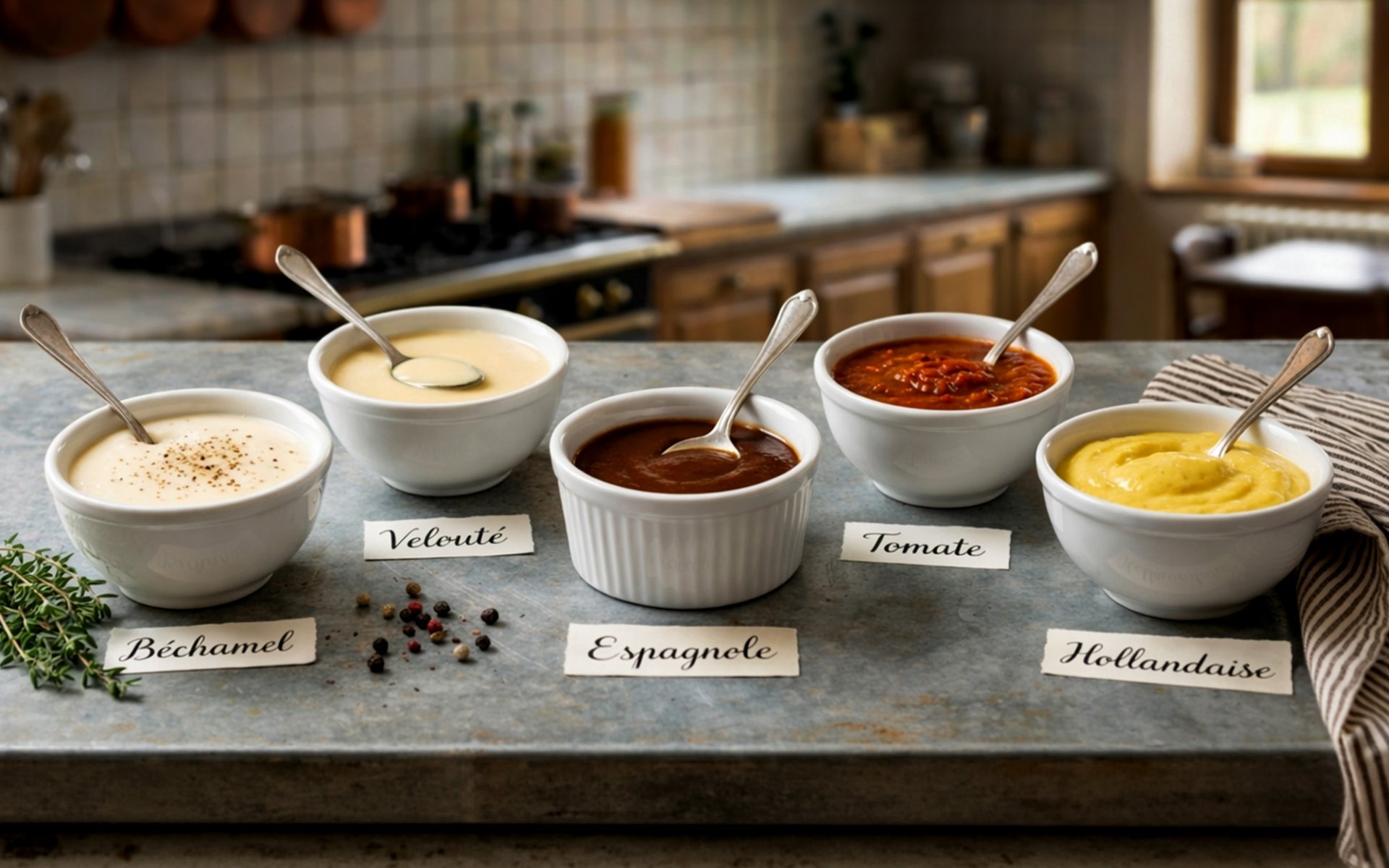
The term “Mother Sauces”, or in French “Sauces Mères,” refers to a group of fundamental sauces that serve as the base for countless derivative sauces, known as Daughter Sauces or Small Sauces. This concept emerged from the effort to organize culinary processes into a structured system, enabling chefs to work more efficiently while maintaining consistency and professional standards in flavor.
During the Middle Ages in Europe, cooking techniques evolved further. People commonly used large amounts of spices and herbs to mask the smell of meat that might not have been fresh. As a result, sauces from this period were often bold, intense, and highly seasoned—frequently made with vinegar, wine, and strong spices.
One of the most influential figures in formalizing French sauces was Marie-Antoine Carême, an 18th-century French chef often referred to as the “King of Chefs.”
In 1833, he introduced the first systematic classification of sauces, identifying four mother sauces:
This resulted in the five mother sauces recognized today:
It is made by creating a white roux and gradually adding warm milk while stirring continuously until smooth and creamy.
Examples of derivatives: Mornay, Cream Sauce, Nantua
Examples of derivatives: Suprême, Allemande, Normande
It is made by roasting bones, creating a rich stock, and combining it with brown roux, mirepoix (onion, carrot, celery), and tomato sauce, then simmering for hours.
Examples of derivatives: Demi-glace, Bordelaise, Robert
Examples of derivatives: Provençale, Creole, Portuguese
Precise temperature control is essential—too much heat will cause the eggs to curdle and the sauce to break. Chefs typically use indirect heat methods such as a double boiler or bain-marie.
Examples of derivatives: Béarnaise, Maltaise, Mousseline
Renowned culinary institutions such as Le Cordon Bleu (Paris) and The Culinary Institute of America (New York) include Mother Sauces as a foundational subject in their curriculum, ensuring students master the basics before advancing to more complex techniques.
The principles behind Mother Sauces have influenced cuisines worldwide. Even though different regions have unique ingredients and traditions, core techniques—such as making roux, creating emulsions, and reducing stocks—can be found across global cuisines, including those of Asia, Latin America, and Africa.
Early Origins of Sauces
The concept of sauces dates back to ancient times. Historical evidence shows that the ancient Romans used a condiment similar to sauce called Garum to enhance the flavor of their dishes. However, sauces during that era were not yet systematically developed or standardized.During the Middle Ages in Europe, cooking techniques evolved further. People commonly used large amounts of spices and herbs to mask the smell of meat that might not have been fresh. As a result, sauces from this period were often bold, intense, and highly seasoned—frequently made with vinegar, wine, and strong spices.
The Birth of Modern French Sauces
A major turning point occurred during the 17th–18th centuries, when French cuisine began to be systematized. Greater emphasis was placed on balance, refinement, and delicate cooking techniques—laying the foundation for modern French sauce-making.One of the most influential figures in formalizing French sauces was Marie-Antoine Carême, an 18th-century French chef often referred to as the “King of Chefs.”
In 1833, he introduced the first systematic classification of sauces, identifying four mother sauces:
- Espagnole
- Velouté
- Béchamel
- Allemande
Escoffier’s Modern System
In the late 19th and early 20th centuries, the system was refined by another legendary chef, Auguste Escoffier. He modernized the classification to better suit contemporary kitchens by removing Allemande sauce (reclassifying it as a derivative of Velouté) and introducing Tomate sauce and Hollandaise sauce.This resulted in the five mother sauces recognized today:
- Béchamel
- Velouté
- Espagnole
- Tomate
- Hollandaise
The Role of Roux
A key element connecting most mother sauces (except Hollandaise) is Roux—a mixture of butter and flour cooked together. Roux acts as a thickening agent and is classified into three types based on color and cooking time:- White Roux
- Blond Roux
- Brown Roux
The Five Mother Sauces
Béchamel Sauce
Béchamel is the simplest of all mother sauces, made from just butter, flour, and milk. Its origins are debated—some attribute it to Louis de Béchameil, a court official under King Louis XIV, while others believe it evolved from Italian sauces introduced by Catherine de’ Medici.It is made by creating a white roux and gradually adding warm milk while stirring continuously until smooth and creamy.
Examples of derivatives: Mornay, Cream Sauce, Nantua
Velouté Sauce
The name Velouté means “velvety,” reflecting its smooth texture. It is similar to Béchamel but uses stock (such as chicken, fish, or veal) instead of milk, resulting in a deeper and more complex flavor.Examples of derivatives: Suprême, Allemande, Normande
Espagnole Sauce
Espagnole is a rich, dark brown sauce and the most complex of the mother sauces. Despite its name meaning “Spanish,” it is not directly Spanish in origin. Historians believe the name may reflect Spanish culinary influence, particularly the introduction of ingredients like tomatoes.It is made by roasting bones, creating a rich stock, and combining it with brown roux, mirepoix (onion, carrot, celery), and tomato sauce, then simmering for hours.
Examples of derivatives: Demi-glace, Bordelaise, Robert
Tomate Sauce
French Tomate sauce differs significantly from common tomato sauces. It has a more complex base, starting with salted pork and aromatic vegetables such as onions, carrots, and garlic, followed by tomatoes and long simmering.Examples of derivatives: Provençale, Creole, Portuguese
Hollandaise Sauce
Hollandaise is one of the most technically challenging mother sauces. Unlike others, it does not use roux but relies on emulsification, using lecithin in egg yolks to bind butter into a smooth, stable sauce.Precise temperature control is essential—too much heat will cause the eggs to curdle and the sauce to break. Chefs typically use indirect heat methods such as a double boiler or bain-marie.
Examples of derivatives: Béarnaise, Maltaise, Mousseline
The concept of Mother Sauces is more than just theory—it serves as a “universal language” for chefs around the world. It provides a structured understanding of sauce-making and allows for creative development of new dishes.
Renowned culinary institutions such as Le Cordon Bleu (Paris) and The Culinary Institute of America (New York) include Mother Sauces as a foundational subject in their curriculum, ensuring students master the basics before advancing to more complex techniques.
The principles behind Mother Sauces have influenced cuisines worldwide. Even though different regions have unique ingredients and traditions, core techniques—such as making roux, creating emulsions, and reducing stocks—can be found across global cuisines, including those of Asia, Latin America, and Africa.
Tags :
Related Content

Fish & Chips: A Simple Dish, Yet Deeply Rooted in Culture, Becoming Englands National Food