Glace de Viande
Last updated: 27 Apr 2026
What Is Glace de Viande and How It Is Made
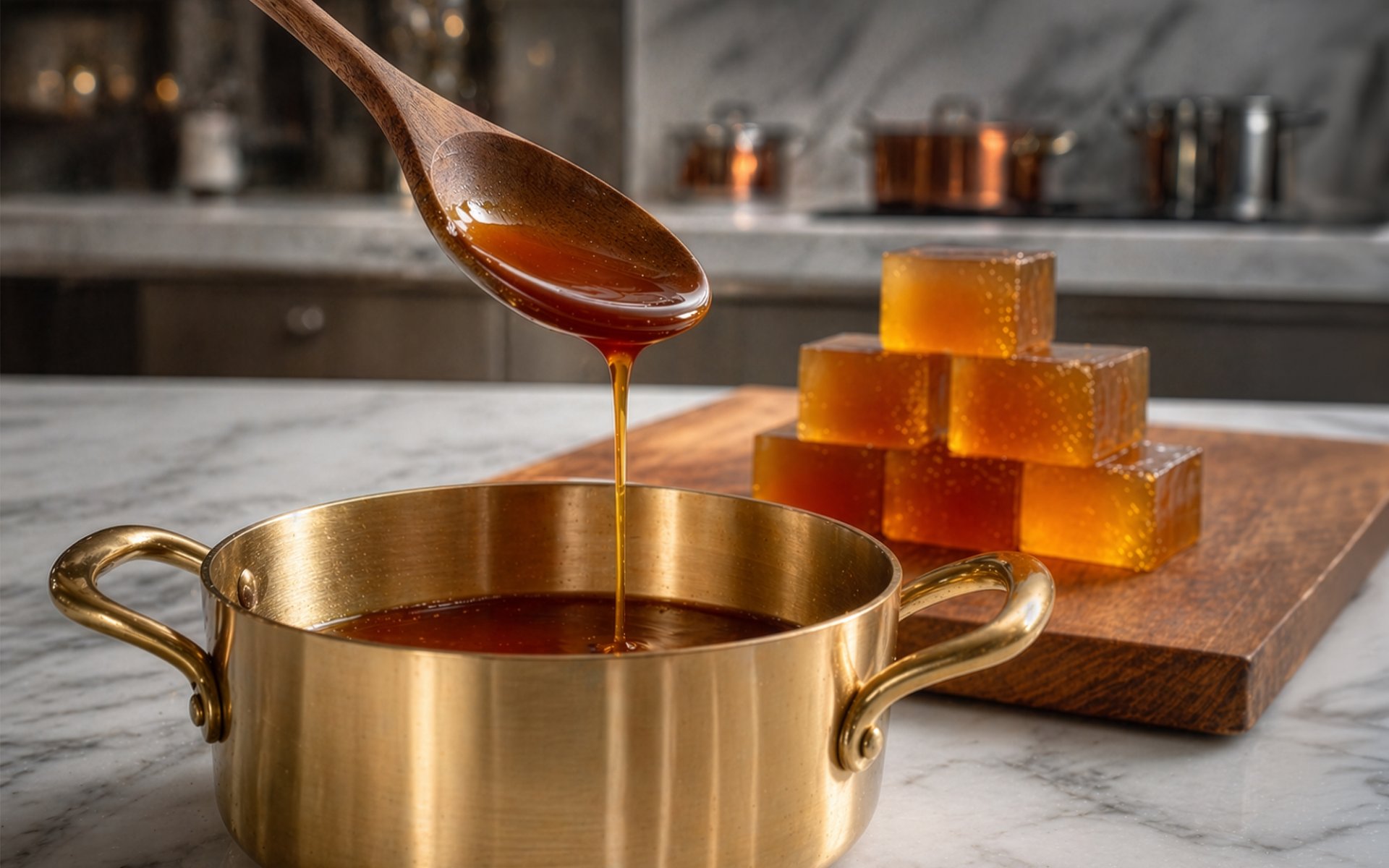
“Glace de Viande” (Glahs de Vee-ahnd), or “Meat Glaze,” is a type of sauce created by taking stock or concentrated broth derived from simmering bones and meat—particularly beef or veal—and subjecting it to a process known as reduction. This process involves simmering the liquid over low heat for an extended period, allowing the water content to gradually evaporate until only a highly concentrated liquid remains. The result is a thick, syrup-like consistency that, when cooled, transforms into a gelatinous form.The Role of Glace de Viande in Haute Cuisine
Glace de Viande is an essential component in Haute Cuisine (French high cuisine). The word “Glace” refers to a glaze or shine, reflecting the glossy appearance of the sauce. In addition to enhancing flavor, it can also be used to coat food, adding both visual appeal and refinement to a dish.The Origins of Stock-Making in Culinary History
To understand the foundation of Glace de Viande, one must trace it back to the origins of stock-making. The practice of extracting flavor from meat and bones is a technique that has existed worldwide since ancient times. In Europe, the preparation of stock began during the medieval period, when soups and potage (thick soups made from vegetables and grains) were widely consumed. At that time, cuisine among the upper classes often involved the use of large quantities of spices. These were used not only to mask undesirable odors but also as a method of food preservation.The Transformation of French Cuisine in the 17th Century
However, in France, a significant transformation began in the 17th century, marking a pivotal moment in the evolution of French cuisine. A key figure in this shift was François Pierre La Varenne, who authored the cookbook Le Cuisinier François in 1651. This work laid the foundation for modern French cooking by moving away from the heavy, spice-laden flavors of medieval cuisine toward a lighter approach that emphasized the natural flavors of ingredients.Standardization of Stock and Reduction Techniques
Standardized methods for preparing stock were also included in this text. These recipes focused primarily on using meats such as beef, lamb, or chicken, without the addition of vegetables or spices, in order to preserve the pure taste of the meat. La Varenne also introduced the technique of reduction, emphasizing careful control to prevent boiling, thereby producing a concentrated broth that retained clarity.Antoine Carême and the Foundation of Mother Sauces
Another major influence that followed was Antoine Carême, a chef who brought Haute Cuisine into the modern era. One of his most significant contributions was the organization and standardization of the “Mother Sauces,” which serve as the foundational sauces of French cuisine.- Velouté, a light-colored sauce made from stock thickened with roux (a mixture of flour and fat),
- Béchamel, a thick sauce made from milk and seasoned with spices,
- Allemande, a sauce derived from Velouté and enriched with egg yolks and cream,
- Espagnole, a brown sauce made from beef or veal stock, also thickened with roux.
Among these, Espagnole is particularly relevant, as its preparation process is closely related to that of Glace de Viande.
Auguste Escoffier and the Development of Glace de Viande
The true establishment of Glace de Viande as a defined culinary element occurred under the influence of Auguste Escoffier, often referred to as “the king of chefs and the chef of kings,” who played a significant role in shaping cuisine during the late 19th and early 20th centuries.Escoffier’s Contribution to Modern French Cuisine
Escoffier’s major contribution was refining and modernizing the work of Carême, making it more accessible, streamlined, and widely adopted. In his seminal work, Le Guide Culinaire, he expanded the number of Mother Sauces from four to five, creating the system that remains the foundation of French cuisine today.Within this work, Escoffier clearly described the preparation and use of Glace de Viande as an ingredient for glazing food, enhancing flavor, and serving as a key component in numerous sauces.
Traditional Method of Making Glace de Viande
Escoffier’s traditional method for preparing Glace de Viande involves taking clarified stock—after removing meat and vegetables—and continuing to simmer it over low heat. The liquid is carefully skimmed and strained through cloth to remove impurities. As the reduction progresses, it is transferred into progressively smaller containers to maintain efficiency, and the process is repeated until the stock reaches a level of concentration where, when a spoon is dipped into it, the liquid fully coats the spoon and adheres without running off.Time and Precision in Reduction Process
This entire process requires more than 10 hours to complete and demands careful adjustment of heat over time. The intensity of Glace de Viande is achieved by reducing the original stock by approximately 80–90 percent.Difference Between Glace de Viande and Demi-glace
However, it is important to distinguish Glace de Viande from Demi-glace, as the two are often confused due to their similar appearance and origins. Demi-glace is made by combining stock with Espagnole sauce and reducing the mixture by approximately half. As a result, it does not achieve the same level of thickness or viscosity as Glace de Viande. Once finished, Demi-glace has the consistency of a brown gravy, with a flavor profile that combines both meat and spices. It is commonly used for seasoning or as a sauce poured over finished dishes.Glace de Viande in the Modern Culinary World
Following the era of Escoffier and the impact of global wars, the culinary world entered an industrial age. As lifestyles became increasingly fast-paced, the practice of making Glace de Viande in ordinary households declined significantly due to its time-consuming process.Glace de Viande in Fine Dining Today
Nevertheless, it can still be found in luxury hotels and fine dining restaurants that specialize in Haute Cuisine. In these settings, the focus remains on precision, craftsmanship, and the authentic essence of ingredients—principles that define high-level culinary tradition. Tags :
Related Content