Romanesco Cauliflower
Last updated: 2 Jul 2026
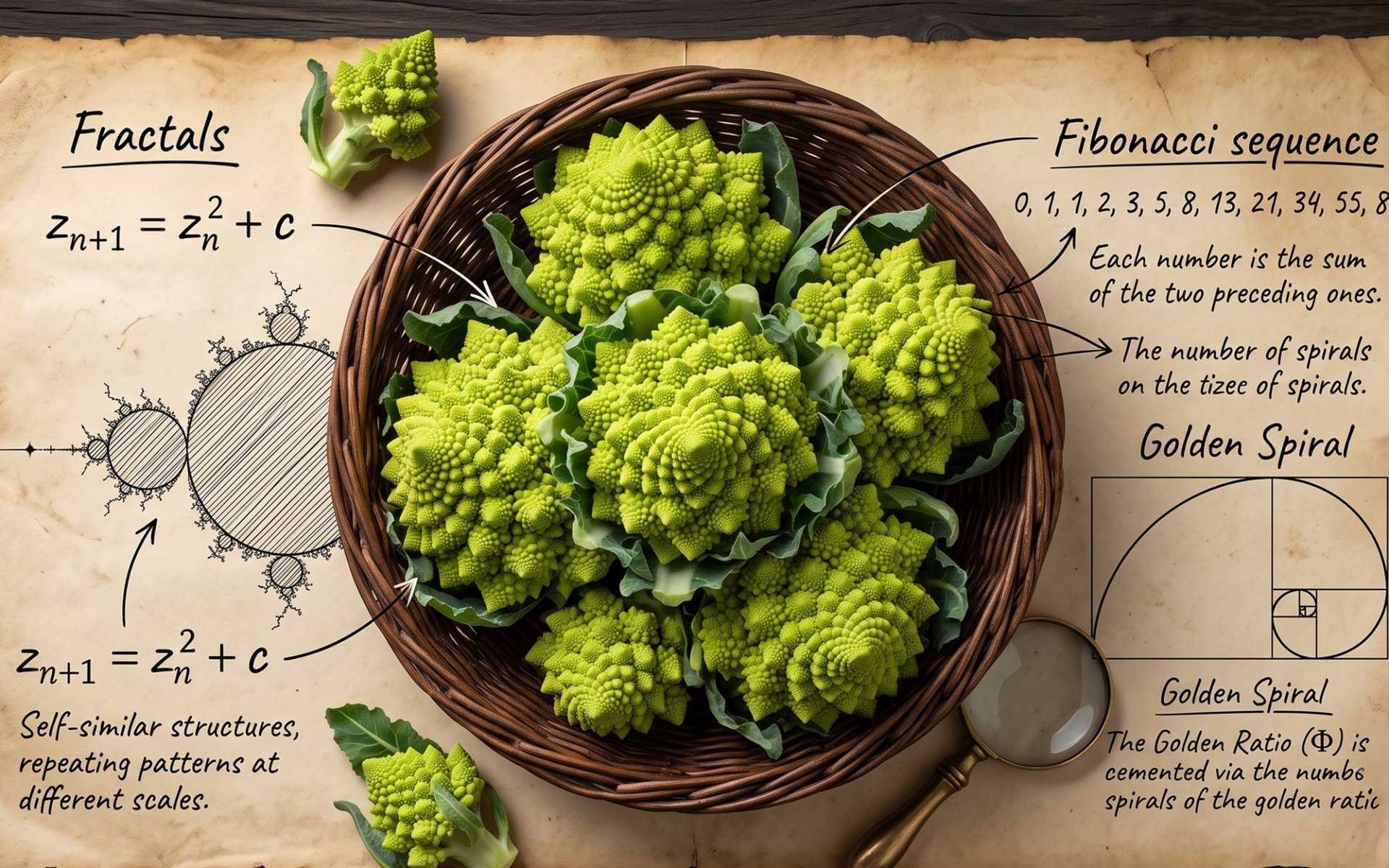
Among all members of the cabbage family, Romanesco Cauliflower, also known as Romanesco broccoli in many countries, is widely regarded as one of the most visually stunning vegetables in the world. In Thailand, it is commonly called Kalam Dok Chedi (Temple Cauliflower) because of its distinctive appearance. Its yellowish-green florets are arranged in perfectly ordered conical spirals, resembling a collection of miniature temple spires that gradually decrease in size.
Romanesco is an Italian variety of cauliflower that has been selectively cultivated for centuries. Although its appearance closely resembles broccoli—leading many people to call it Romanesco broccoli—botanists confirm that it is not a hybrid between broccoli and cauliflower, as is commonly believed. Instead, it is a unique cauliflower cultivar that has been carefully selected by Italian farmers over generations for its remarkable shape, color, and flavor. In fact, it has been cultivated for centuries, long before the development of the modern white cauliflower.
During the Renaissance, Italy was not only the center of art and culture but also a hub of botanical and agricultural innovation. Scholars and noble families devoted considerable effort to collecting and studying plant species, while farmers in the countryside surrounding Rome carefully selected cabbage plants with the most beautifully arranged flower buds. Through generations of traditional breeding and seed selection, they gradually developed the perfectly geometric structure that characterizes Romanesco today.
One historical reference confirming the long-standing presence of Romanesco in Rome appears in the writings of Giuseppe Gioachino Belli, a renowned 19th-century Italian poet celebrated for documenting the daily life, language, and culture of the Roman people through poetry written in the Roman dialect. His works mention "Broccolo Romanesco" as a familiar local vegetable commonly found in markets and household kitchens throughout the city.
Although Romanesco had long been cultivated in Italy, the name Romanesco Cauliflower only gained widespread international recognition during the late 20th century, as European horticultural exports expanded and global demand for specialty vegetables increased.
A fractal is a geometric shape that exhibits self-similarity, meaning the same pattern repeats itself at different scales. No matter how closely you zoom in, the smaller structures resemble the larger whole. In Romanesco, if you break off a single cone-shaped floret, it looks almost identical to the entire head. Looking even closer at the smallest buds reveals the same repeating pattern again and again.
Beyond its fractal geometry, Romanesco also follows the Fibonacci sequence, the famous mathematical pattern discovered by the Italian mathematician Leonardo Pisano, better known as Fibonacci. The sequence begins with 0 and 1, with each subsequent number equal to the sum of the previous two: 0, 1, 1, 2, 3, 5, 8, 13, 21, 34, 55...
If you count the spiral rows running clockwise and counterclockwise across the head of a Romanesco, the numbers almost always correspond to two consecutive Fibonacci numbers, such as 8 and 13 or 13 and 21. This arrangement allows the plant to pack the greatest possible number of flower buds into a limited space while maximizing sunlight exposure and promoting efficient growth.
Using the model plant Arabidopsis thaliana, a member of the same botanical family as cauliflower, the researchers investigated how flower buds develop. They discovered that Romanesco's fractal architecture results from an unusual developmental process. The growing tissue begins to form flowers but repeatedly fails to complete floral development. Instead, it reverts to producing new shoots, which in turn attempt—and fail—to become flowers, repeating the cycle continuously.
Each repetition grows slightly faster than the previous one, producing progressively smaller cone-shaped shoots arranged in precise spirals. This repeated developmental cycle ultimately creates Romanesco's spectacular fractal structure. The study not only explained the vegetable's remarkable appearance but also provided valuable insights into the developmental biology of Brassica crops.
Romanesco therefore represents far more than an unusually beautiful vegetable. It serves as a remarkable example of the intersection between biology, mathematics, and plant evolution, making it one of nature's finest demonstrations of geometric perfection.
It can be prepared in numerous ways:
Romanesco is an Italian variety of cauliflower that has been selectively cultivated for centuries. Although its appearance closely resembles broccoli—leading many people to call it Romanesco broccoli—botanists confirm that it is not a hybrid between broccoli and cauliflower, as is commonly believed. Instead, it is a unique cauliflower cultivar that has been carefully selected by Italian farmers over generations for its remarkable shape, color, and flavor. In fact, it has been cultivated for centuries, long before the development of the modern white cauliflower.
The Origins : "Roman Broccoli" of the Renaissance
The history of Romanesco dates back to the 15th and 16th centuries in the Lazio region, home to the city of Rome, Italy. Historical agricultural records from the period refer to the vegetable as "Broccolo Romanesco," literally meaning "Roman broccoli."During the Renaissance, Italy was not only the center of art and culture but also a hub of botanical and agricultural innovation. Scholars and noble families devoted considerable effort to collecting and studying plant species, while farmers in the countryside surrounding Rome carefully selected cabbage plants with the most beautifully arranged flower buds. Through generations of traditional breeding and seed selection, they gradually developed the perfectly geometric structure that characterizes Romanesco today.
One historical reference confirming the long-standing presence of Romanesco in Rome appears in the writings of Giuseppe Gioachino Belli, a renowned 19th-century Italian poet celebrated for documenting the daily life, language, and culture of the Roman people through poetry written in the Roman dialect. His works mention "Broccolo Romanesco" as a familiar local vegetable commonly found in markets and household kitchens throughout the city.
Although Romanesco had long been cultivated in Italy, the name Romanesco Cauliflower only gained widespread international recognition during the late 20th century, as European horticultural exports expanded and global demand for specialty vegetables increased.
A Mathematical Marvel: Fractals and the Fibonacci Sequence
As Romanesco became more widely known, it also attracted the attention of scientists and mathematicians because of its remarkable fractal structure.A fractal is a geometric shape that exhibits self-similarity, meaning the same pattern repeats itself at different scales. No matter how closely you zoom in, the smaller structures resemble the larger whole. In Romanesco, if you break off a single cone-shaped floret, it looks almost identical to the entire head. Looking even closer at the smallest buds reveals the same repeating pattern again and again.
Beyond its fractal geometry, Romanesco also follows the Fibonacci sequence, the famous mathematical pattern discovered by the Italian mathematician Leonardo Pisano, better known as Fibonacci. The sequence begins with 0 and 1, with each subsequent number equal to the sum of the previous two: 0, 1, 1, 2, 3, 5, 8, 13, 21, 34, 55...
If you count the spiral rows running clockwise and counterclockwise across the head of a Romanesco, the numbers almost always correspond to two consecutive Fibonacci numbers, such as 8 and 13 or 13 and 21. This arrangement allows the plant to pack the greatest possible number of flower buds into a limited space while maximizing sunlight exposure and promoting efficient growth.
The Science Behind the Shape
For many years, scientists wondered why Romanesco develops such an extraordinary shape. The mystery was finally explained in 2021, when a research team led by Christophe Godin and François Parcy published a groundbreaking study in the journal Science.Using the model plant Arabidopsis thaliana, a member of the same botanical family as cauliflower, the researchers investigated how flower buds develop. They discovered that Romanesco's fractal architecture results from an unusual developmental process. The growing tissue begins to form flowers but repeatedly fails to complete floral development. Instead, it reverts to producing new shoots, which in turn attempt—and fail—to become flowers, repeating the cycle continuously.
Each repetition grows slightly faster than the previous one, producing progressively smaller cone-shaped shoots arranged in precise spirals. This repeated developmental cycle ultimately creates Romanesco's spectacular fractal structure. The study not only explained the vegetable's remarkable appearance but also provided valuable insights into the developmental biology of Brassica crops.
Romanesco therefore represents far more than an unusually beautiful vegetable. It serves as a remarkable example of the intersection between biology, mathematics, and plant evolution, making it one of nature's finest demonstrations of geometric perfection.
Culinary Versatility and Nutritional Benefits
Beyond its extraordinary appearance, Romanesco is also prized by chefs and consumers worldwide for its distinctive flavor, exceptional nutritional value, and culinary versatility. Compared with conventional cauliflower, Romanesco has a firmer, crunchier texture, a naturally mild sweetness, and a subtle nutty flavor.It can be prepared in numerous ways:
- Steaming or Blanching: Helps preserve both its vibrant yellowish-green color and crisp texture.
- Roasting: Tossing it with olive oil, salt, and black pepper before roasting enhances its natural sweetness and delicate nutty aroma.
- Sautéing and Pasta: Following traditional Italian cooking methods, it is commonly cooked with garlic, dried chili peppers, olive oil, and grated cheese before being tossed with pasta, resulting in a simple yet deeply flavorful dish.
- Vitamins & Fiber: An excellent source of vitamin C, vitamin K, and dietary fiber.
- Antioxidants: Rich in carotenoids that help protect cells from oxidative damage.
- Phytochemicals: Like other cruciferous vegetables, it contains beneficial compounds such as glucosinolates and isothiocyanates.
Tags :
Related Content

Pappardelle al Cinghiale: Experience the Taste of Tuscany with Wild Boar Ragù Pasta


How to Steam and Blanch Green Vegetables Without Losing Their Nutritional Value While Keeping Their Vibrant Color