Jerusalem Artichoke
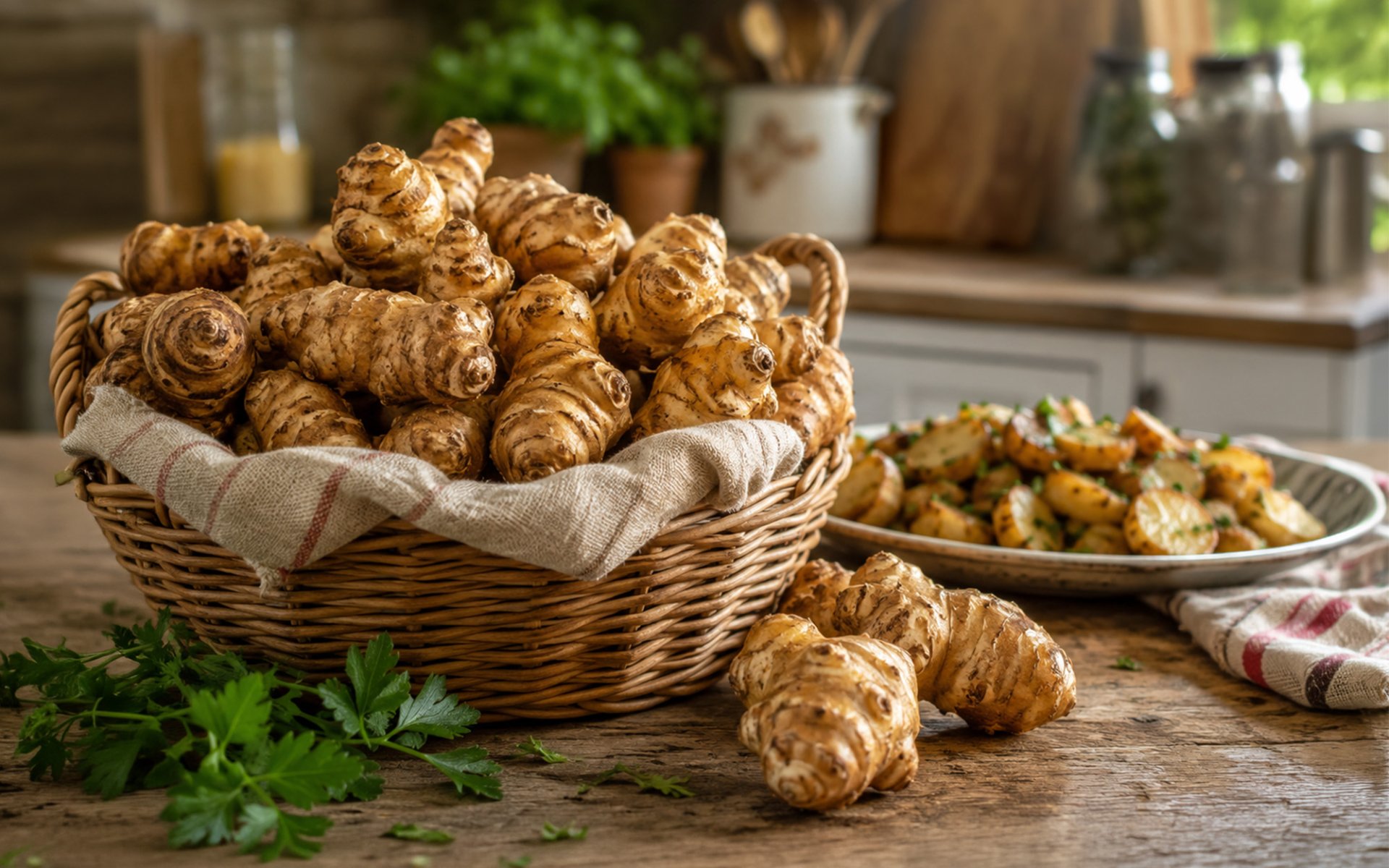
Also known as Sunchoke (and widely known in Thailand as "Kaen Tawan"), Jerusalem artichoke (Helianthus tuberosus) is a tuber-producing perennial belonging to the sunflower family (Asteraceae). It is native to central and eastern North America, covering much of what is now the United States and southern Canada.
From Native American Staple to European Discovery
Historical evidence suggests that Native American peoples were the first to cultivate Jerusalem artichokes, growing them for centuries as an important food source. The plant was highly valued because it was easy to cultivate, resilient under a wide range of environmental conditions, and capable of storing edible tubers underground for extended periods. The tubers were enjoyed both raw and cooked.A major turning point in the history of Jerusalem artichoke came in the early seventeenth century, when the French explorer Samuel de Champlain encountered the plant while exploring the eastern coast of North America. At Nauset Harbor, in present-day Massachusetts, he observed Indigenous communities cultivating the tubers as a staple food. After tasting them himself, Champlain noted that their flavor resembled that of the globe artichoke familiar to Europeans. Impressed by their taste, he brought specimens back to Europe.
Upon arriving in Europe, the tubers were cultivated by the Dutch botanist Petrus Hondius. Although the tubers had become somewhat shriveled during the long sea voyage, they adapted remarkably well to European soils and climate, growing vigorously and propagating far more rapidly than expected.
The Fascinating Origins of Its Names
One of the most fascinating aspects of Jerusalem artichoke is the origin of its English name, which has long been debated by historians and linguists. Several theories have been proposed, with one in particular gaining the widest acceptance:
According to the most widely accepted explanation, the name is linked to the Italian word girasole, meaning "sunflower." When the plant was introduced to Italy, people noticed that its flowers closely resembled those of the sunflower and began calling it girasole. As the word spread into English-speaking communities, its pronunciation gradually evolved over time until it eventually became "Jerusalem."
The origin of the word "artichoke" is somewhat more straightforward. Samuel de Champlain recorded that the tubers tasted remarkably similar to the globe artichoke already well known throughout Europe. As a result, the familiar term "artichoke" became attached to the plant despite the fact that the two species are botanically unrelated.
In French, Jerusalem artichoke is known as Topinambour, a name that arose from an intriguing historical misunderstanding. In 1613, members of the Tupinambá people from the Brazilian coast were brought to France at roughly the same time that Jerusalem artichoke was becoming known in Europe. Many Europeans mistakenly assumed that the newly introduced tuber had originated in Brazil and had arrived alongside the Tupinambá people. In reality, the Tupinambá lived in tropical regions where Jerusalem artichoke could not be cultivated successfully and were unfamiliar with the plant altogether. Nevertheless, this misunderstanding became deeply rooted in French culture, and Topinambour remains the standard French name for Jerusalem artichoke to this day.
Following its introduction to Europe during the early seventeenth century, Jerusalem artichoke rapidly gained popularity as a hardy crop that was easy to cultivate, thrived in cool climates, and produced abundant harvests. France was among the first countries to embrace its cultivation, after which it spread throughout the Netherlands, England, Germany, and many other parts of Europe.
Botanical Characteristics and Culinary Uses
Jerusalem artichoke is a perennial herbaceous plant that can grow up to three meters (approximately ten feet) tall. Its leaves have a rough texture, while its bright yellow flowers closely resemble small sunflowers.
The edible portion is the underground tuber, which is irregularly shaped and often resembles ginger or a small taro root. Depending on the variety, the skin ranges from light brown to reddish-purple, while the flesh inside is white. It has a mildly sweet flavor and develops a soft, potato-like texture when cooked.
The Power of Inulin: A Prebiotic Superfood
One of the characteristics that distinguishes Jerusalem artichoke from most other root vegetables is that it stores its energy primarily in the form of inulin rather than starch.
Inulin is a soluble dietary fiber classified as a prebiotic, which is not easily digested or absorbed by the human body. Consequently, Jerusalem artichoke has a lower glycemic index than many other tuber crops. Fresh tubers may contain up to approximately 76 percent inulin on a dry-weight basis, making them an exceptionally rich natural source of this beneficial carbohydrate.
Inulin is a polymer composed mainly of fructose molecules and plays an important role in supporting digestive health while helping to regulate blood sugar levels. Because of these properties, Jerusalem artichoke has attracted growing interest among nutritionists and researchers, particularly as a functional food suitable for individuals seeking to manage blood glucose levels and promote a healthy gut microbiome.
Today, Jerusalem artichoke has experienced a resurgence in popularity among nutrition professionals, chefs, and health-conscious consumers around the world. Its distinctive flavor, versatility in the kitchen, and impressive nutritional profile have earned it recognition as one of the most promising alternative root vegetables in modern cuisine and nutrition.