Masala Chai
Last updated: 29 Jul 2026
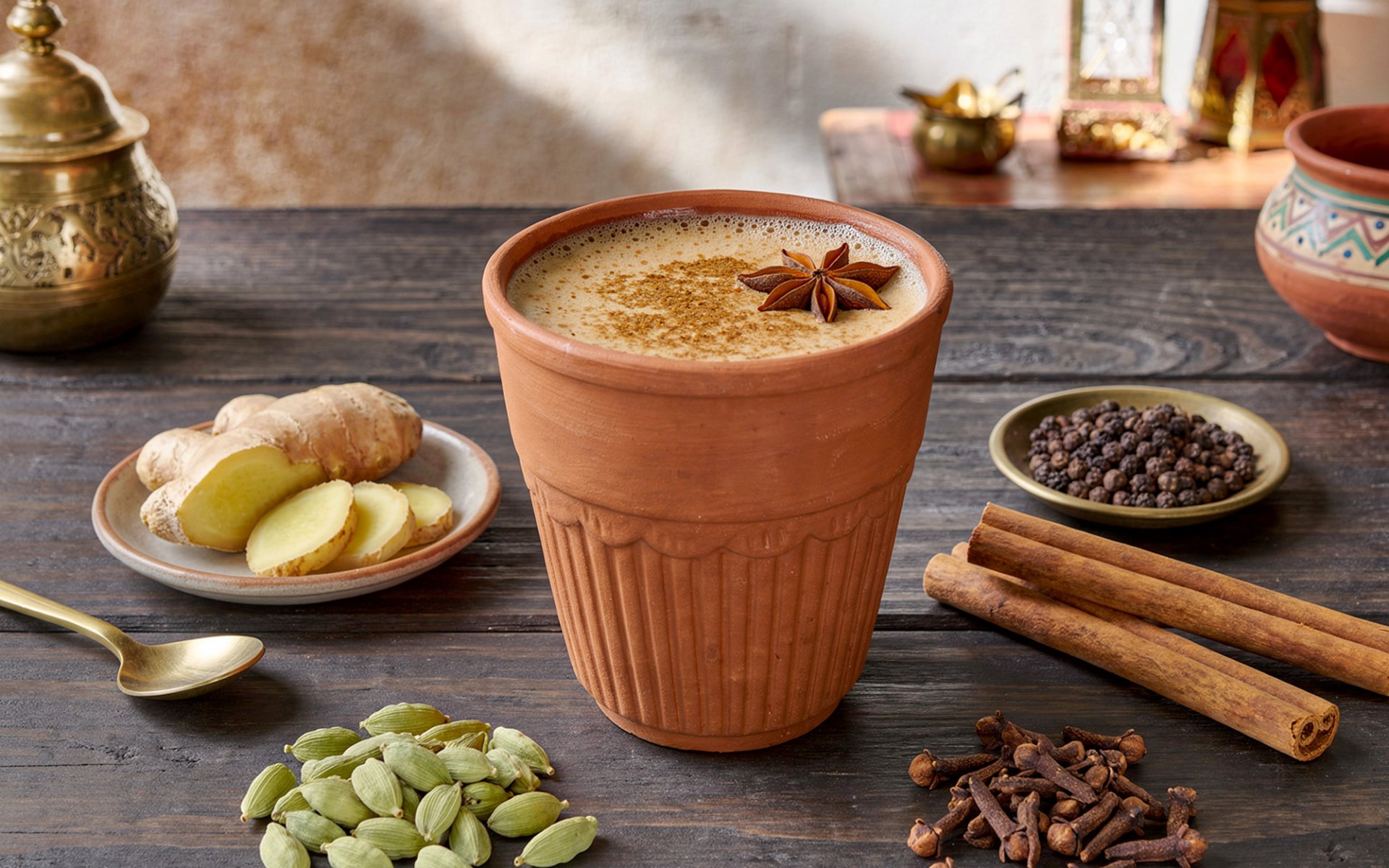
Masala Chai is a distinctive Indian-style spiced milk tea made by simmering strong black tea with milk, sweeteners, and a variety of aromatic spices such as green cardamom, ginger, cinnamon, cloves, and black pepper. The result is a warm and comforting beverage with a rich aroma of herbs and spices, a smooth sweetness, a creamy texture, and a gentle hint of spiciness.
According to traditional legends, India’s herbal spice-infused beverages may have a history stretching back thousands of years. Some accounts suggest that these drinks originated in the royal court of King Harshavardhana, the ruler of northern India during the 7th century. It is believed that the king consumed such beverages to maintain alertness during administrative duties and also served them to welcome royal guests visiting the court.
During that era, these herbal beverages were often referred to as “Kadha”, meaning a decoction made by boiling herbs and spices. They were prepared according to Ayurvedic principles to restore health and maintain balance within the body based on the concept of the three Doshas: Vata, Pitta, and Kapha.
Each spice used in these traditional beverages was selected based on its believed medicinal properties, including:
Ginger — traditionally believed to support digestion, relieve cold symptoms, and reduce inflammation.
Green Cardamom — valued for its refreshing aroma and believed to support heart health, digestion, and freshen breath.
Cinnamon — traditionally associated with improving circulation and helping regulate blood sugar levels.
Cloves — recognized for their antimicrobial properties and ability to relieve discomfort.
Black Pepper — believed to provide warmth, stimulate metabolism, and enhance nutrient absorption.
However, these early herbal beverages did not contain tea leaves or caffeine. They were simply combinations of herbs and spices prepared according to Ayurvedic traditions, with the primary purpose of promoting wellness, balancing the body, and supporting health rather than serving as a recreational beverage.
At that time, tea had become an increasingly popular beverage among the British population. However, most of the tea consumed in Britain was imported from China, creating a significant trade imbalance as Britain had to spend vast amounts of silver to purchase tea.
To address this economic challenge, Britain began exporting opium cultivated in India to China in exchange for silver and tea, eventually leading to conflicts known as the Opium Wars — a series of conflicts between Qing China and Western powers caused partly by Britain’s illegal opium trade used to offset its trade deficit.
As a result of these tensions, along with growing concerns over political and economic dependence on China, Britain began searching for alternative tea-producing regions within its own empire.
Initially, British authorities attempted to cultivate Chinese tea varieties in India. However, these efforts faced difficulties because many regions lacked suitable climate and soil conditions. The resulting tea crops were often of lower quality and unable to compete with Chinese tea, leading to further exploration for a tea variety better suited to India’s environment.
A significant breakthrough came in 1823, when Robert Bruce, a Scottish explorer, discovered a native tea plant growing naturally in the forests of Assam in northeastern India. This variety, known as Camellia sinensis var. assamica, had distinctive characteristics: large leaves, strong adaptability to hot and humid climates, and the ability to produce black tea with a deep color, bold flavor, and higher caffeine content compared with Chinese tea varieties.
This discovery marked a crucial moment in the history of Indian tea. The British East India Company accelerated the development of the tea industry by establishing large-scale tea plantations in Assam before expanding cultivation to other regions with suitable growing conditions.
Although the tea industry during this period relied heavily on strict labor systems and involved extremely difficult working conditions, Indian tea production expanded rapidly. By the late 19th century, India had become one of the world’s major tea producers and exporters, eventually becoming a key supplier of tea for the British market and reducing Britain’s dependence on Chinese tea.
The situation began to change in the early 20th century, particularly after the Great Depression, which severely affected international trade. The decline in global demand for tea caused India’s tea production to exceed market demand, resulting in falling prices and surplus stock. To address this crisis, the Indian Tea Association, which was still largely managed by British interests at the time, began searching for new markets. They eventually recognized that the most promising market was the hundreds of millions of people within India itself — a population that had previously received little attention as tea consumers.
The Indian Tea Association launched a large-scale national advertising campaign with significant investment to encourage Indians to drink tea. Tea carts and promotional staff were sent to major cities, railway stations, and industrial areas to offer free samples while educating people about the traditional British method of preparing tea — brewing black tea in hot water and adding milk and a small amount of sugar. In addition, the association encouraged factories to introduce “tea breaks” for workers, helping establish tea-drinking habits in a systematic way.
As a result, Indian roadside tea vendors, known as “Chaiwallahs,” began adapting the British tea-drinking style by combining it with traditional Indian knowledge of herbs and spices, allowing them to create an affordable beverage for the general population.
They reduced the amount of tea leaves used and added easily available, lower-cost spices such as ginger, cardamom, cinnamon, and black pepper. Instead of simply steeping tea leaves in hot water and adding milk afterward, they developed a method of simmering tea leaves together with water, milk, sugar, and spices in a single pot for an extended period. This technique extracted the full flavors and aromas of both the tea and spices, while the sweetness and creaminess of the milk softened the bitterness of the tea, creating a richer, smoother beverage that also provided more energy.
This style of tea later became known as “Masala Chai.”
Initially, the Indian Tea Association did not support this approach because adding large amounts of milk and spices reduced tea consumption, which contradicted their campaign goal of increasing the use of tea leaves. Historical records indicate that the association produced promotional materials encouraging what they considered the “proper” way to prepare tea and attempted to discourage the excessive use of spices, arguing that it diminished the value of tea and resulted in the use of fewer tea leaves.
However, these efforts could not overcome the growing popularity of this new style of tea. Masala Chai successfully matched both the taste preferences and lifestyle of Indian consumers. The beverage not only provided warmth and energy but also preserved the traditional Indian concept of using spices for wellness, reflecting the influence of Ayurvedic principles that had existed for centuries.
A Global Icon of Indian Culture
Today, Masala Chai is recognized as one of India’s most famous and distinctive beverages. It can be found everywhere, from traditional tea stalls and modern cafés to restaurants around the world. Although Masala Chai recipes have been adapted to suit the preferences of consumers in different countries, its essential character remains unchanged — the harmonious combination of black tea, spices, milk, and the careful process of simmering that creates a unique flavor reflecting the history, culture, and wisdom of the Indian subcontinent.
The Roots of Masala Chai: Ayurveda and the Ancient “Kadha”
Before tea became an integral part of Indian culture, the people of India had a long tradition of consuming herbal drinks infused with spices as part of Ayurvedic medicine, the ancient Indian system of healing. These beverages were prepared using various herbs and spices, with the purpose of nourishing the body and alleviating illnesses.According to traditional legends, India’s herbal spice-infused beverages may have a history stretching back thousands of years. Some accounts suggest that these drinks originated in the royal court of King Harshavardhana, the ruler of northern India during the 7th century. It is believed that the king consumed such beverages to maintain alertness during administrative duties and also served them to welcome royal guests visiting the court.
During that era, these herbal beverages were often referred to as “Kadha”, meaning a decoction made by boiling herbs and spices. They were prepared according to Ayurvedic principles to restore health and maintain balance within the body based on the concept of the three Doshas: Vata, Pitta, and Kapha.
Each spice used in these traditional beverages was selected based on its believed medicinal properties, including:
Ginger — traditionally believed to support digestion, relieve cold symptoms, and reduce inflammation.
Green Cardamom — valued for its refreshing aroma and believed to support heart health, digestion, and freshen breath.
Cinnamon — traditionally associated with improving circulation and helping regulate blood sugar levels.
Cloves — recognized for their antimicrobial properties and ability to relieve discomfort.
Black Pepper — believed to provide warmth, stimulate metabolism, and enhance nutrient absorption.
However, these early herbal beverages did not contain tea leaves or caffeine. They were simply combinations of herbs and spices prepared according to Ayurvedic traditions, with the primary purpose of promoting wellness, balancing the body, and supporting health rather than serving as a recreational beverage.
The Arrival of Tea and the Transformation of Indian Spiced Beverages
The major turning point that introduced tea into India’s herbal spice-based beverage culture occurred during the 19th century, when the British Empire expanded its influence in India through the British East India Company.At that time, tea had become an increasingly popular beverage among the British population. However, most of the tea consumed in Britain was imported from China, creating a significant trade imbalance as Britain had to spend vast amounts of silver to purchase tea.
To address this economic challenge, Britain began exporting opium cultivated in India to China in exchange for silver and tea, eventually leading to conflicts known as the Opium Wars — a series of conflicts between Qing China and Western powers caused partly by Britain’s illegal opium trade used to offset its trade deficit.
As a result of these tensions, along with growing concerns over political and economic dependence on China, Britain began searching for alternative tea-producing regions within its own empire.
Initially, British authorities attempted to cultivate Chinese tea varieties in India. However, these efforts faced difficulties because many regions lacked suitable climate and soil conditions. The resulting tea crops were often of lower quality and unable to compete with Chinese tea, leading to further exploration for a tea variety better suited to India’s environment.
A significant breakthrough came in 1823, when Robert Bruce, a Scottish explorer, discovered a native tea plant growing naturally in the forests of Assam in northeastern India. This variety, known as Camellia sinensis var. assamica, had distinctive characteristics: large leaves, strong adaptability to hot and humid climates, and the ability to produce black tea with a deep color, bold flavor, and higher caffeine content compared with Chinese tea varieties.
This discovery marked a crucial moment in the history of Indian tea. The British East India Company accelerated the development of the tea industry by establishing large-scale tea plantations in Assam before expanding cultivation to other regions with suitable growing conditions.
Although the tea industry during this period relied heavily on strict labor systems and involved extremely difficult working conditions, Indian tea production expanded rapidly. By the late 19th century, India had become one of the world’s major tea producers and exporters, eventually becoming a key supplier of tea for the British market and reducing Britain’s dependence on Chinese tea.
The Great Depression and the Push for a New Market
However, despite India becoming one of the world’s leading tea producers, most of the tea produced during the early period was exported to Europe. Ordinary Indians did not consume tea as part of their daily lives because tea leaves were expensive and were largely regarded as a beverage associated with the upper classes and the colonial authorities.The situation began to change in the early 20th century, particularly after the Great Depression, which severely affected international trade. The decline in global demand for tea caused India’s tea production to exceed market demand, resulting in falling prices and surplus stock. To address this crisis, the Indian Tea Association, which was still largely managed by British interests at the time, began searching for new markets. They eventually recognized that the most promising market was the hundreds of millions of people within India itself — a population that had previously received little attention as tea consumers.
The Indian Tea Association launched a large-scale national advertising campaign with significant investment to encourage Indians to drink tea. Tea carts and promotional staff were sent to major cities, railway stations, and industrial areas to offer free samples while educating people about the traditional British method of preparing tea — brewing black tea in hot water and adding milk and a small amount of sugar. In addition, the association encouraged factories to introduce “tea breaks” for workers, helping establish tea-drinking habits in a systematic way.
The Ingenuity of the "Chaiwallah": The Birth of Masala Chai
Although the campaign successfully introduced tea consumption to a wider Indian population, it faced two major challenges. First, the flavor of British-style tea did not fully match Indian preferences. Second, tea leaves remained too expensive for many ordinary people to consume regularly.As a result, Indian roadside tea vendors, known as “Chaiwallahs,” began adapting the British tea-drinking style by combining it with traditional Indian knowledge of herbs and spices, allowing them to create an affordable beverage for the general population.
They reduced the amount of tea leaves used and added easily available, lower-cost spices such as ginger, cardamom, cinnamon, and black pepper. Instead of simply steeping tea leaves in hot water and adding milk afterward, they developed a method of simmering tea leaves together with water, milk, sugar, and spices in a single pot for an extended period. This technique extracted the full flavors and aromas of both the tea and spices, while the sweetness and creaminess of the milk softened the bitterness of the tea, creating a richer, smoother beverage that also provided more energy.
This style of tea later became known as “Masala Chai.”
Initially, the Indian Tea Association did not support this approach because adding large amounts of milk and spices reduced tea consumption, which contradicted their campaign goal of increasing the use of tea leaves. Historical records indicate that the association produced promotional materials encouraging what they considered the “proper” way to prepare tea and attempted to discourage the excessive use of spices, arguing that it diminished the value of tea and resulted in the use of fewer tea leaves.
However, these efforts could not overcome the growing popularity of this new style of tea. Masala Chai successfully matched both the taste preferences and lifestyle of Indian consumers. The beverage not only provided warmth and energy but also preserved the traditional Indian concept of using spices for wellness, reflecting the influence of Ayurvedic principles that had existed for centuries.
A Global Icon of Indian Culture
Today, Masala Chai is recognized as one of India’s most famous and distinctive beverages. It can be found everywhere, from traditional tea stalls and modern cafés to restaurants around the world. Although Masala Chai recipes have been adapted to suit the preferences of consumers in different countries, its essential character remains unchanged — the harmonious combination of black tea, spices, milk, and the careful process of simmering that creates a unique flavor reflecting the history, culture, and wisdom of the Indian subcontinent.
Tags :
Related Content


Tracing the History of Root Beer Float : The Classic American Ice Cream Drink That Has Delighted Generations