Salade Niçoise
Last updated: 6 Aug 2026
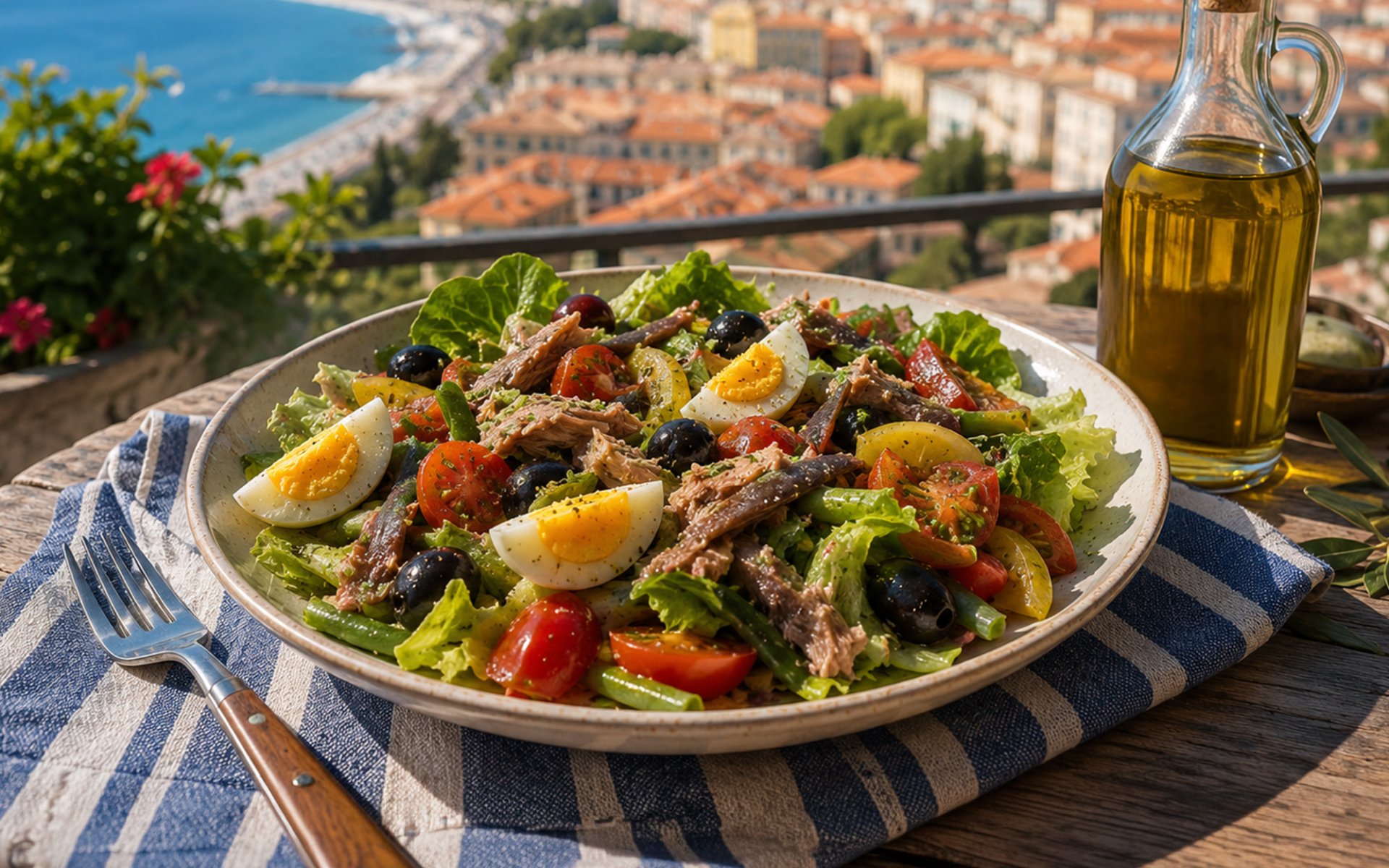
Salade Niçoise is widely regarded as one of France's most celebrated culinary creations and one of the world's most recognizable salads. Renowned for its vibrant colors, refreshing flavors, and wholesome nutritional profile, the dish combines fresh Mediterranean ingredients such as tomatoes, olives, anchovies, and olive oil into a simple yet elegant composition. Today, it is widely recognized as one of the quintessential expressions of the Mediterranean Diet, celebrated for its emphasis on fresh, seasonal, and minimally processed ingredients.
In its earliest form, Salade Niçoise was far simpler than the version familiar to diners today. It did not originally include lettuce, boiled potatoes, green beans, or canned tuna—ingredients that became popular additions only in the decades that followed. For this reason, many food historians regard Salade Niçoise as a classic example of Mediterranean peasant cuisine, reflecting the philosophy of making the best use of fresh, seasonal local produce while embodying the modest lifestyle of the people of Nice.
For this reason, Pan Bagnat is often described as Salade Niçoise in sandwich form. The close relationship between the two dishes offers valuable insight into the authentic composition of the original salad, which emphasized raw, fresh local ingredients with very little cooking involved, apart from salt-cured anchovies.
His adaptation reflected the principles of Haute Cuisine, transforming a rustic local dish into one suitable for elegant restaurants and grand hotels. However, the revised recipe was met with strong criticism from the people of Nice. Although Escoffier was born in Villeneuve-Loubet, only a short distance from Nice, many locals considered him an outsider who did not truly represent the city's culinary heritage.
As a result, organizations dedicated to preserving the traditional cuisine of Nice, such as Le Cercle de la Capelina d'Or, have continued to defend the original recipe. They maintain that adding potatoes or green beans fundamentally alters the identity of Salade Niçoise and have long advocated for recognition of the authentic version as an important part of Nice's cultural heritage.
However, despite strong opposition from the people of Nice, Escoffier's version ultimately became enormously influential in the culinary world. Le Guide Culinaire was adopted as a standard reference in culinary schools and professional kitchens around the globe, leading the potato-and-green-bean variation of Salade Niçoise to become the version most familiar to international audiences. Meanwhile, the people of Nice have continued to maintain that the authentic Salade Niçoise should remain faithful to its original form, celebrating simplicity and the freshness of local ingredients above all else.
Médecin also argued that authentic Salade Niçoise should never include cooked vegetables such as potatoes or green beans, which he regarded as later additions. Instead, he recommended preparing the salad in a wooden bowl rubbed with fresh garlic to impart a subtle aroma, while allowing only raw seasonal vegetables such as cucumber, young purple artichokes, green bell peppers, young broad beans, spring onions, Niçoise olives, and fresh basil. Above all, every vegetable should be served raw, preserving the freshness that defines the dish.
Nevertheless, many French chefs continue to champion the traditional approach. Eric Ripert, the Michelin-starred French chef, has explained that when tuna is used in Salade Niçoise according to French culinary tradition, it should preferably be canned tuna preserved in olive oil, rather than fresh or seared tuna, which has become common in many countries. His perspective reflects a broader belief among many French chefs that, despite the countless variations found around the world, respect for the dish's original ingredients and regional heritage remains paramount.
Even within France, the debate over the "true" Salade Niçoise continues. A notable example occurred when Cyril Lignac sparked widespread discussion on social media after presenting a recipe that included both potatoes and green beans, prompting criticism from many who believed it departed too far from the traditional Niçois philosophy.
Although the recipe has evolved over time, the essence of Salade Niçoise remains unchanged: a celebration of exceptional ingredients. Whether prepared with ripe tomatoes, hard-boiled eggs, intensely flavored Niçoise olives, premium extra virgin olive oil, anchovies, or tuna, the salad continues to embody the philosophy of Mediterranean cuisine—one that values freshness, simplicity, seasonality, and the authentic flavors of high-quality ingredients.
Origins: A Humble Fishermen's Meal in Nice
The origins of Salade Niçoise can be traced to the city of Nice on the French Riviera during the 19th century. Originally, it was a humble meal enjoyed by local fishermen and working families, who prepared it using ingredients that were readily available along the Mediterranean coast. Ripe tomatoes, salted anchovies, black olives, and extra virgin olive oil formed the foundation of the dish, providing both nourishment and energy for a day's work.In its earliest form, Salade Niçoise was far simpler than the version familiar to diners today. It did not originally include lettuce, boiled potatoes, green beans, or canned tuna—ingredients that became popular additions only in the decades that followed. For this reason, many food historians regard Salade Niçoise as a classic example of Mediterranean peasant cuisine, reflecting the philosophy of making the best use of fresh, seasonal local produce while embodying the modest lifestyle of the people of Nice.
Cuisine Niçoise: A Blend of French and Italian Heritage
The identity of Salade Niçoise is also deeply intertwined with the history of Nice itself. For centuries, the city belonged to the Kingdom of Sardinia and maintained strong cultural and culinary ties with neighboring Italy before officially becoming part of France in 1860. This unique historical background gave rise to Cuisine Niçoise—a distinctive regional cuisine that blends French and Italian influences. Alongside Salade Niçoise, other celebrated specialties include Socca, a chickpea flour flatbread, and Pissaladière, a savory tart topped with caramelized onions and anchovies.Pan Bagnat: The Salad in a Sandwich
Many culinary historians also believe that Salade Niçoise is closely related to another traditional specialty from Nice known as Pan Bagnat. In the Niçard dialect, Pan Bagnat literally means "bathed bread" or "soaked bread." The sandwich originated as an ingenious way to revive stale bread by filling it with the same ingredients found in Salade Niçoise, allowing the juices from ripe tomatoes and the olive oil to soften the bread until it became tender once again.For this reason, Pan Bagnat is often described as Salade Niçoise in sandwich form. The close relationship between the two dishes offers valuable insight into the authentic composition of the original salad, which emphasized raw, fresh local ingredients with very little cooking involved, apart from salt-cured anchovies.
The Culinary Controversy: Auguste Escoffier’s Additions
A major turning point in the history of Salade Niçoise—and one that continues to spark culinary debate today—occurred in 1903 when Auguste Escoffier, widely regarded as the father of modern French cuisine, included his own interpretation of the dish in Le Guide Culinaire, one of the most influential cookbooks in Western culinary history. Escoffier introduced boiled potatoes and green beans into the recipe, ingredients that had never been part of the traditional Niçois version.His adaptation reflected the principles of Haute Cuisine, transforming a rustic local dish into one suitable for elegant restaurants and grand hotels. However, the revised recipe was met with strong criticism from the people of Nice. Although Escoffier was born in Villeneuve-Loubet, only a short distance from Nice, many locals considered him an outsider who did not truly represent the city's culinary heritage.
As a result, organizations dedicated to preserving the traditional cuisine of Nice, such as Le Cercle de la Capelina d'Or, have continued to defend the original recipe. They maintain that adding potatoes or green beans fundamentally alters the identity of Salade Niçoise and have long advocated for recognition of the authentic version as an important part of Nice's cultural heritage.
However, despite strong opposition from the people of Nice, Escoffier's version ultimately became enormously influential in the culinary world. Le Guide Culinaire was adopted as a standard reference in culinary schools and professional kitchens around the globe, leading the potato-and-green-bean variation of Salade Niçoise to become the version most familiar to international audiences. Meanwhile, the people of Nice have continued to maintain that the authentic Salade Niçoise should remain faithful to its original form, celebrating simplicity and the freshness of local ingredients above all else.
Defining the Authentic Recipe: Jacques Médecin’s Rules
In 1972, Jacques Médecin—former Mayor of Nice and an influential culinary author—published La Cuisine du Comté de Nice, one of the definitive references on the traditional cuisine of the Nice region. In the book, he clearly defined the principles of an authentic Salade Niçoise. Tomatoes, he insisted, must remain the centerpiece of the salad and should first be lightly salted to enhance their flavor before being dressed with high-quality olive oil. The salad should be served with hard-boiled eggs and should contain either anchovies or tuna—but never both together.Médecin also argued that authentic Salade Niçoise should never include cooked vegetables such as potatoes or green beans, which he regarded as later additions. Instead, he recommended preparing the salad in a wooden bowl rubbed with fresh garlic to impart a subtle aroma, while allowing only raw seasonal vegetables such as cucumber, young purple artichokes, green bell peppers, young broad beans, spring onions, Niçoise olives, and fresh basil. Above all, every vegetable should be served raw, preserving the freshness that defines the dish.
Global Popularity and the Influence of Julia Child
Although debate over the authentic recipe continues in France, the worldwide popularity of Salade Niçoise owes much to its inclusion in influential cookbooks and international culinary media. Among the most significant figures was Julia Child, whose landmark cookbook Mastering the Art of French Cooking introduced a version featuring potatoes and green beans. As the book became enormously influential throughout the English-speaking world, many people came to associate Salade Niçoise with these cooked ingredients rather than with the traditional salad of Nice.The Rise of Canned Tuna in Modern Interpretations
The evolution of Salade Niçoise was also shaped by broader changes in food culture during the early twentieth century. As Western-style salads gained popularity across Europe and commercially canned tuna became increasingly available, tuna gradually replaced anchovies in many versions of the dish. Over time, canned tuna became one of the defining ingredients of the internationally recognized Salade Niçoise, despite the fact that traditional Niçois recipes historically placed greater emphasis on anchovies.Nevertheless, many French chefs continue to champion the traditional approach. Eric Ripert, the Michelin-starred French chef, has explained that when tuna is used in Salade Niçoise according to French culinary tradition, it should preferably be canned tuna preserved in olive oil, rather than fresh or seared tuna, which has become common in many countries. His perspective reflects a broader belief among many French chefs that, despite the countless variations found around the world, respect for the dish's original ingredients and regional heritage remains paramount.
Salade Niçoise Today: A Flexible Icon of Mediterranean Cuisine
Today, Salade Niçoise appears on restaurant menus across the globe and has been adapted to suit local tastes and culinary traditions. Some establishments remain faithful to the original Niçois recipe built around fresh, uncooked vegetables, while others follow the interpretation popularized by Auguste Escoffier, incorporating boiled potatoes and green beans—a version that has become widely recognized in international cuisine.Even within France, the debate over the "true" Salade Niçoise continues. A notable example occurred when Cyril Lignac sparked widespread discussion on social media after presenting a recipe that included both potatoes and green beans, prompting criticism from many who believed it departed too far from the traditional Niçois philosophy.
Although the recipe has evolved over time, the essence of Salade Niçoise remains unchanged: a celebration of exceptional ingredients. Whether prepared with ripe tomatoes, hard-boiled eggs, intensely flavored Niçoise olives, premium extra virgin olive oil, anchovies, or tuna, the salad continues to embody the philosophy of Mediterranean cuisine—one that values freshness, simplicity, seasonality, and the authentic flavors of high-quality ingredients.
Tags :
Related Content