Naengmyeon (냉면)
Last updated: 31 Aug 2026
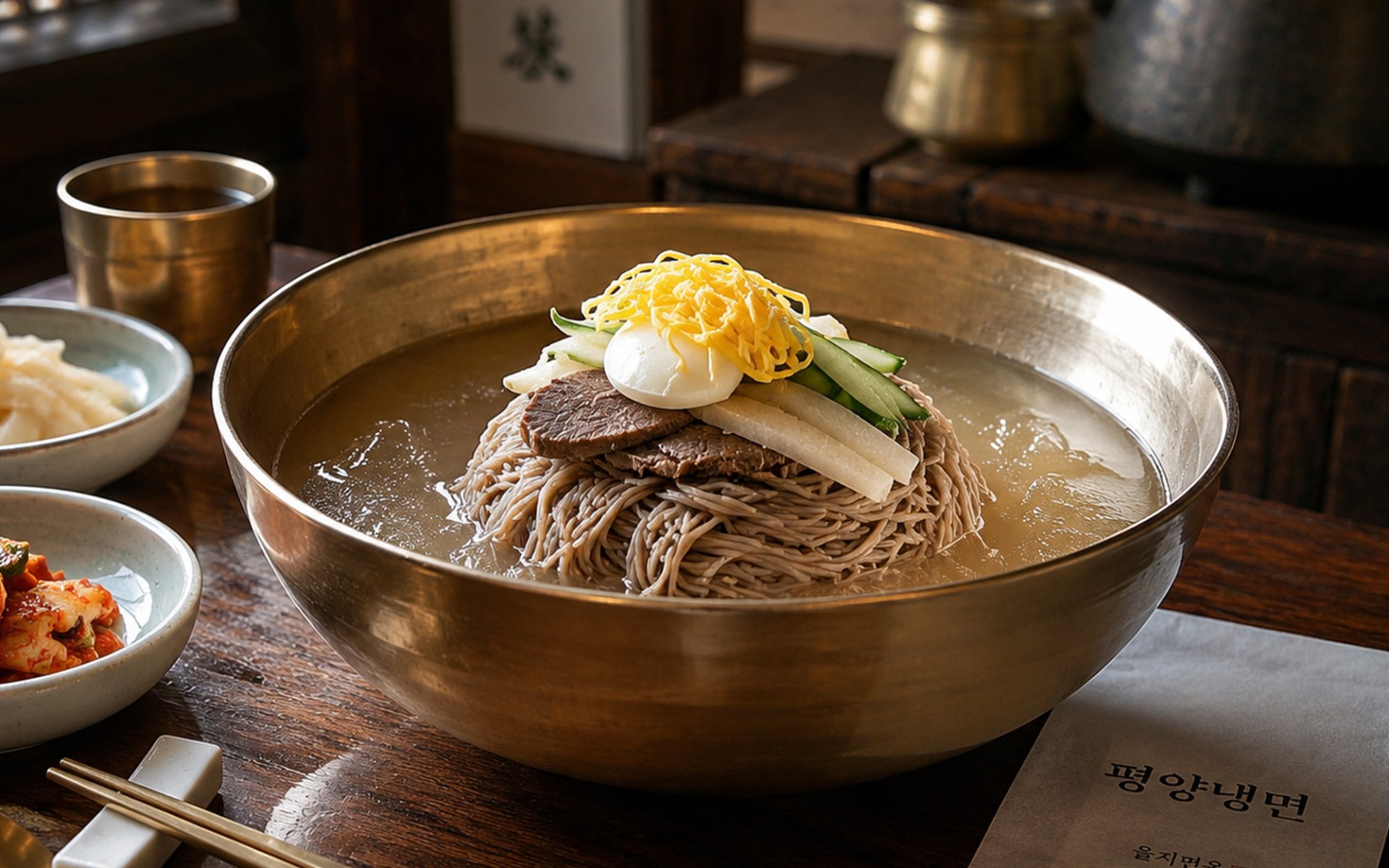
Naengmyeon (냉면), or Korean cold noodles, is a traditional Korean dish commonly enjoyed as a refreshing meal during hot weather. It is characterized by chewy and tender noodles made from buckwheat flour, potato starch, or sweet potato starch, served with refreshing toppings such as cucumber, Korean pear, and boiled egg. There are two main varieties: Mul Naengmyeon, a noodle dish served in an icy cold broth, and Bibim Naengmyeon, a dry version tossed in a spicy and flavorful gochujang-based sauce.
Although this reference does not contain the word “Naengmyeon” itself, it provides important evidence that the concept and culture of eating cold noodles had already existed in Korean society for centuries, long before the name “Naengmyeon” became clearly established in later periods.
By the 17th century, the name Naengmyeon appeared in writings by Korean scholars and members of the aristocracy. Some records describe cold noodles served with a broth flavored with Omija, a native Korean fruit known for its distinctive sour taste. These records suggest that early versions of Naengmyeon may have differed considerably from the dish familiar today, with sour and refreshing broths forming an important part of the dish.
During this period, Naengmyeon was not merely a local food enjoyed by ordinary people. It was also served at the Joseon royal court. One historical figure associated with a particular fondness for Naengmyeon was King Gojong (1852–1919), the final king of the Joseon Dynasty and the first emperor of the Korean Empire.
According to historical accounts, King Gojong preferred foods with mild and delicate flavors. He was said to enjoy Naengmyeon served in chilled Dongchimi broth, a watery radish kimchi, accompanied by sliced meat, pine nuts, and thinly sliced Korean pear. He reportedly enjoyed the dish as a late-evening snack. This story illustrates that Naengmyeon was not restricted to any particular social class, but had become part of Korea’s food culture across different levels of society.
In its early history, Naengmyeon did not necessarily rely on buckwheat as the primary ingredient for its noodles. The use of buckwheat developed particularly in the northern regions of the Korean Peninsula, where mountainous terrain and cold weather made agriculture more challenging. Some areas also had limited fertile land and water resources, making the cultivation of rice—which requires relatively warm conditions and abundant water—more difficult than in southern regions.
As a result, people in these regions increasingly cultivated crops that were better adapted to the local environment. Buckwheat, in particular, could grow in relatively cool climates and had a short growing season. Root crops such as potatoes and sweet potatoes were also cultivated and later used as important ingredients in noodle production.
Another major variety is Hamheung Naengmyeon, which originated in the eastern coastal city of Hamhung. It differs noticeably from Pyongyang Naengmyeon. The noodles are typically made with potato or sweet potato starch, giving them a chewier, more elastic, and resilient texture than buckwheat noodles.
Hamheung Naengmyeon is commonly served as Bibim Naengmyeon, in which the noodles are tossed with a spicy gochujang-based sauce. It may be topped with thinly sliced raw fish, such as skate, or sliced beef, creating a bold combination of spicy, sweet, and sour flavors.
One of the most significant events was the Hungnam Evacuation, during which large numbers of North Korean civilians fled southward to escape the war.
Many refugees from Pyongyang and Hamhung brought recipes and knowledge of Naengmyeon preparation with them. After beginning new lives in South Korea, many families opened restaurants as a means of earning a living. One well-known example is Ojang-dong Hamheung Naengmyeon in Seoul, which was established in 1953 and became one of the restaurants that helped preserve and pass on the culinary traditions of Hamheung-style Naengmyeon in South Korea.
There are also Naengmyeon restaurants in Daejeon that preserve recipes and culinary knowledge passed down through families with roots in Pyongyang.
A notable example is Milmyeon, a noodle dish associated with the city of Busan. It is connected to refugees from the northern regions who faced difficulty obtaining sufficient quantities of buckwheat. As a result, wheat flour was used as the primary ingredient instead. This produced noodles with a texture different from traditional Naengmyeon and eventually gave rise to a distinctive local dish associated with Busan.
Another dish connected to South Korea’s noodle industry is Jjolmyeon, which originated in Incheon in the early 1970s. According to the commonly told account, the dish emerged from a mistake during noodle production when a factory produced noodles that were thicker than the required standard.
Rather than discarding them, the noodles were experimented with and served with gochujang-based sauce and various toppings. The result was a new dish characterized by its exceptionally chewy texture, which eventually became popular throughout South Korea.
The story of Naengmyeon after the Korean War demonstrates that it was not simply a dish that traveled from north to south. It is also an example of how food can adapt to major social and historical changes.
From being a regional specialty of northern Korea, Naengmyeon eventually became an important part of South Korean food culture. Its evolution also gave rise to new varieties of noodle dishes, reflecting not only the memories and culinary traditions carried by displaced communities, but also their ability to adapt to new environments and circumstances.
Early Origins of Cold Noodles in Korean Literature
The concept of cold noodles can be traced back to Korean literature as early as the late Goryeo Dynasty (918–1392). Historical evidence suggests that the scholar Lee Saek, who lived from 1328 to 1396, mentioned cold noodles in one of his poems, using the term “냉도” (Naengdo).Although this reference does not contain the word “Naengmyeon” itself, it provides important evidence that the concept and culture of eating cold noodles had already existed in Korean society for centuries, long before the name “Naengmyeon” became clearly established in later periods.
Naengmyeon During the Joseon Dynasty: From Commoners to the Royal Court
During the Joseon Dynasty (1392–1897), historical references to Naengmyeon became more concrete. One important source is the diary of Lee Mun-geon, which contains an entry from April 1558 describing how his feet felt cold after eating Naengmyeon during a midday rest. This record suggests that the term “Naengmyeon,” or a closely related term, was already in use in Korean society by the middle of the 16th century.By the 17th century, the name Naengmyeon appeared in writings by Korean scholars and members of the aristocracy. Some records describe cold noodles served with a broth flavored with Omija, a native Korean fruit known for its distinctive sour taste. These records suggest that early versions of Naengmyeon may have differed considerably from the dish familiar today, with sour and refreshing broths forming an important part of the dish.
During this period, Naengmyeon was not merely a local food enjoyed by ordinary people. It was also served at the Joseon royal court. One historical figure associated with a particular fondness for Naengmyeon was King Gojong (1852–1919), the final king of the Joseon Dynasty and the first emperor of the Korean Empire.
According to historical accounts, King Gojong preferred foods with mild and delicate flavors. He was said to enjoy Naengmyeon served in chilled Dongchimi broth, a watery radish kimchi, accompanied by sliced meat, pine nuts, and thinly sliced Korean pear. He reportedly enjoyed the dish as a late-evening snack. This story illustrates that Naengmyeon was not restricted to any particular social class, but had become part of Korea’s food culture across different levels of society.
Northern Origins and the Introduction of Buckwheat
Although the culture of eating cold noodles has ancient roots, the forms of Naengmyeon known today developed significantly in the northern regions of the Korean Peninsula, particularly Pyeongan-do, Hamgyeong-do, and Hwanghae-do.In its early history, Naengmyeon did not necessarily rely on buckwheat as the primary ingredient for its noodles. The use of buckwheat developed particularly in the northern regions of the Korean Peninsula, where mountainous terrain and cold weather made agriculture more challenging. Some areas also had limited fertile land and water resources, making the cultivation of rice—which requires relatively warm conditions and abundant water—more difficult than in southern regions.
As a result, people in these regions increasingly cultivated crops that were better adapted to the local environment. Buckwheat, in particular, could grow in relatively cool climates and had a short growing season. Root crops such as potatoes and sweet potatoes were also cultivated and later used as important ingredients in noodle production.
Regional Variations: Pyongyang Naengmyeon vs. Hamheung Naengmyeon
One of the most famous varieties from this region is Pyongyang Naengmyeon, which became the model for what is now commonly known as Mul Naengmyeon. Its noodles traditionally contain a high proportion of buckwheat, giving them a soft texture with a slightly coarse character and a distinctive aroma. They are served in a chilled broth based on meat stock and fermented or pickled vegetable liquids, such as kimchi or Dongchimi broth. The resulting flavor is relatively mild and delicate, emphasizing the refreshing quality of the cold broth rather than intense seasoning.Another major variety is Hamheung Naengmyeon, which originated in the eastern coastal city of Hamhung. It differs noticeably from Pyongyang Naengmyeon. The noodles are typically made with potato or sweet potato starch, giving them a chewier, more elastic, and resilient texture than buckwheat noodles.
Hamheung Naengmyeon is commonly served as Bibim Naengmyeon, in which the noodles are tossed with a spicy gochujang-based sauce. It may be topped with thinly sliced raw fish, such as skate, or sliced beef, creating a bold combination of spicy, sweet, and sour flavors.
The Korean War and the Journey of Naengmyeon to the South
One of the most significant turning points in the history of Naengmyeon came during the Korean War (1950–1953), particularly after Chinese forces entered the war in late 1950 and pushed United Nations and South Korean forces southward. This led to a massive movement of civilians from the northern regions of the Korean Peninsula.One of the most significant events was the Hungnam Evacuation, during which large numbers of North Korean civilians fled southward to escape the war.
Many refugees from Pyongyang and Hamhung brought recipes and knowledge of Naengmyeon preparation with them. After beginning new lives in South Korea, many families opened restaurants as a means of earning a living. One well-known example is Ojang-dong Hamheung Naengmyeon in Seoul, which was established in 1953 and became one of the restaurants that helped preserve and pass on the culinary traditions of Hamheung-style Naengmyeon in South Korea.
There are also Naengmyeon restaurants in Daejeon that preserve recipes and culinary knowledge passed down through families with roots in Pyongyang.
Culinary Adaptations: The Birth of Milmyeon and Jjolmyeon
The migration of people from the north to the south did more than spread Naengmyeon to new regions. It also led to adaptations based on the ingredients and resources available in different areas.A notable example is Milmyeon, a noodle dish associated with the city of Busan. It is connected to refugees from the northern regions who faced difficulty obtaining sufficient quantities of buckwheat. As a result, wheat flour was used as the primary ingredient instead. This produced noodles with a texture different from traditional Naengmyeon and eventually gave rise to a distinctive local dish associated with Busan.
Another dish connected to South Korea’s noodle industry is Jjolmyeon, which originated in Incheon in the early 1970s. According to the commonly told account, the dish emerged from a mistake during noodle production when a factory produced noodles that were thicker than the required standard.
Rather than discarding them, the noodles were experimented with and served with gochujang-based sauce and various toppings. The result was a new dish characterized by its exceptionally chewy texture, which eventually became popular throughout South Korea.
The story of Naengmyeon after the Korean War demonstrates that it was not simply a dish that traveled from north to south. It is also an example of how food can adapt to major social and historical changes.
From being a regional specialty of northern Korea, Naengmyeon eventually became an important part of South Korean food culture. Its evolution also gave rise to new varieties of noodle dishes, reflecting not only the memories and culinary traditions carried by displaced communities, but also their ability to adapt to new environments and circumstances.
Tags :
Related Content

Get to Know Halo-halo: The Filipino Dessert with Simple Foundations and Endless Possibilities

Tracing the Culinary and Travel Passions of Ernest Miller Hemingway, Renowned Nobel Laureate Author