Banana Shallot
Last updated: 13 Jul 2026
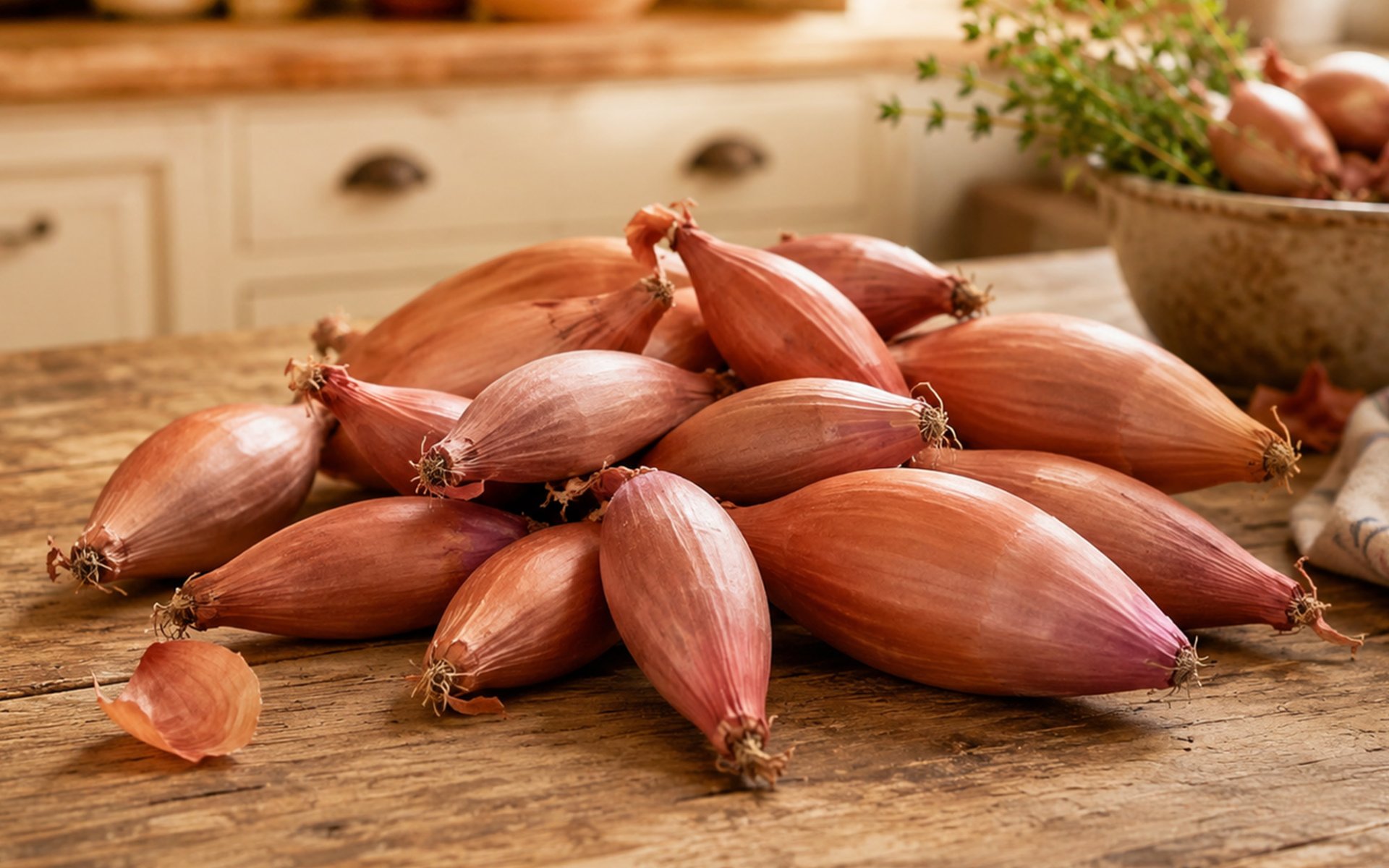
The Banana Shallot is an elongated shallot whose shape resembles a small banana, giving rise to its common English name. This distinctive variety is easily recognized by its golden-brown to copper-colored skin, which resembles that of a brown onion, while its flesh ranges from creamy white to pale purple, similar to traditional shallots. It is, however, noticeably larger than the shallots most people are familiar with.
Like other cultivated shallots, the Banana Shallot belongs to the Allium cepa Aggregatum Group. Most botanists believe that the ancestors of modern shallots originated in Western and Central Asia before spreading through ancient trade routes into Persia, India, East Asia, and the Mediterranean region. From there, shallots reached Europe during the Middle Ages, where they quickly became an indispensable culinary ingredient, particularly in France, whose rich culinary tradition elevated the shallot to one of the foundations of classic French cooking.
France is home to numerous Banana Shallot cultivars, each with its own distinct name, including Jermor, Cuisse de Poulet du Poitou, Zebrune, Échalote Grise, and Long Red Florence. While these varieties differ slightly in skin color, size, shape, and flavor intensity, they all share the defining characteristics of elongated bulbs, delicate aroma, and a naturally sweet, mild taste.
Commercially, the term "Banana Shallot" does not refer to a single cultivar but rather to a group of elongated shallots that are significantly larger than conventional shallots. In France, this type is more commonly known as Échalion, a name derived from the combination of the French words échalote (shallot) and oignon (onion), reflecting its intermediate appearance.
Thanks to its mild sweetness and refined aroma, the Banana Shallot is exceptionally versatile in the kitchen. It is widely used in dishes such as red wine sauce, Beurre Blanc, salad dressings, roasted whole shallots, and caramelized preparations—classic examples of European, and especially French, cuisine, where the natural flavor of each ingredient is carefully preserved and celebrated.
Among them is Tom Aikens, the celebrated London chef and former holder of two Michelin stars, who has described the Banana Shallot as combining the best qualities of both onions and shallots. According to Aikens, it offers the convenience of an onion in terms of preparation while retaining the delicate sweetness and elegant aroma that make shallots so highly prized.
The English name "Banana Shallot" is widely believed to have been inspired by the bulb's elongated, banana-like shape. Although some people argue that its form more closely resembles a torpedo than a banana, the name has proven memorable and consumer-friendly, leading to its widespread adoption throughout the retail and food-service industries.
Today, the United Kingdom has become one of Europe's leading producers of Banana Shallots. Commercial cultivation is concentrated in the eastern counties, including Bedfordshire, Cambridgeshire, Suffolk, and Norfolk, where sandy loam soils and a temperate climate provide ideal growing conditions for alliums. Harvesting generally begins in September, with supplies continuing through May or June of the following year.
In addition to France and the United Kingdom, Banana Shallots are also cultivated commercially in Belgium and exported throughout Europe as well as to the United States, where they continue to gain popularity among consumers seeking premium-quality culinary ingredients.
Following reviews by the French agricultural authorities and the European Union, Banana Shallots were officially recognized as a distinct category that could be marketed internationally under the names Banana Shallot or Échalion. Within France, however, regulations continue to require the use of the name Échalion on product labels in order to distinguish these modern cultivated varieties from traditional French shallots and to help consumers better understand their origin and method of cultivation.
Like other cultivated shallots, the Banana Shallot belongs to the Allium cepa Aggregatum Group. Most botanists believe that the ancestors of modern shallots originated in Western and Central Asia before spreading through ancient trade routes into Persia, India, East Asia, and the Mediterranean region. From there, shallots reached Europe during the Middle Ages, where they quickly became an indispensable culinary ingredient, particularly in France, whose rich culinary tradition elevated the shallot to one of the foundations of classic French cooking.
The Origin and Development of the "Échalion" in France
The Banana Shallot was developed in France through continuous selective breeding to produce bulbs that are longer, larger, and easier to peel than traditional shallots. Breeders also sought to enhance desirable characteristics such as coppery-brown skin, firm flesh, a consistently high yield, and a naturally sweeter, milder flavor. These qualities soon made Banana Shallots a favorite among professional chefs and an essential ingredient in French cuisine before their cultivation spread widely throughout the United Kingdom and other European countries.France is home to numerous Banana Shallot cultivars, each with its own distinct name, including Jermor, Cuisse de Poulet du Poitou, Zebrune, Échalote Grise, and Long Red Florence. While these varieties differ slightly in skin color, size, shape, and flavor intensity, they all share the defining characteristics of elongated bulbs, delicate aroma, and a naturally sweet, mild taste.
Commercially, the term "Banana Shallot" does not refer to a single cultivar but rather to a group of elongated shallots that are significantly larger than conventional shallots. In France, this type is more commonly known as Échalion, a name derived from the combination of the French words échalote (shallot) and oignon (onion), reflecting its intermediate appearance.
Thanks to its mild sweetness and refined aroma, the Banana Shallot is exceptionally versatile in the kitchen. It is widely used in dishes such as red wine sauce, Beurre Blanc, salad dressings, roasted whole shallots, and caramelized preparations—classic examples of European, and especially French, cuisine, where the natural flavor of each ingredient is carefully preserved and celebrated.
Growing Popularity in the United Kingdom
Although Banana Shallots have long been cultivated in France, they experienced a remarkable rise in popularity in the United Kingdom during the twenty-first century. Several renowned British chefs helped introduce this unique shallot to a broader international audience.Among them is Tom Aikens, the celebrated London chef and former holder of two Michelin stars, who has described the Banana Shallot as combining the best qualities of both onions and shallots. According to Aikens, it offers the convenience of an onion in terms of preparation while retaining the delicate sweetness and elegant aroma that make shallots so highly prized.
The English name "Banana Shallot" is widely believed to have been inspired by the bulb's elongated, banana-like shape. Although some people argue that its form more closely resembles a torpedo than a banana, the name has proven memorable and consumer-friendly, leading to its widespread adoption throughout the retail and food-service industries.
Today, the United Kingdom has become one of Europe's leading producers of Banana Shallots. Commercial cultivation is concentrated in the eastern counties, including Bedfordshire, Cambridgeshire, Suffolk, and Norfolk, where sandy loam soils and a temperate climate provide ideal growing conditions for alliums. Harvesting generally begins in September, with supplies continuing through May or June of the following year.
In addition to France and the United Kingdom, Banana Shallots are also cultivated commercially in Belgium and exported throughout Europe as well as to the United States, where they continue to gain popularity among consumers seeking premium-quality culinary ingredients.
The Great Classification Debate
During the 1990s, the classification of Banana Shallots became the subject of considerable debate in France. Growers and regulatory authorities disagreed over whether this elongated variety should officially be classified as a traditional shallot. France has long maintained strict horticultural standards designed to protect the identity and quality of its agricultural products, particularly traditional shallots that have historically been propagated through bulb division rather than from seed.Following reviews by the French agricultural authorities and the European Union, Banana Shallots were officially recognized as a distinct category that could be marketed internationally under the names Banana Shallot or Échalion. Within France, however, regulations continue to require the use of the name Échalion on product labels in order to distinguish these modern cultivated varieties from traditional French shallots and to help consumers better understand their origin and method of cultivation.
Distinctive Characteristics and Culinary Uses
One of the Banana Shallot's most distinctive physical characteristics is its large, elongated bulb, which may reach 4–5 inches (10–13 cm) in length. The outer skin ranges from golden brown to copper in color, while the flesh is creamy white, with some cultivars displaying delicate pink or purple layers between the scales.- Easy Preparation: Its generous size and elongated form make it much easier to peel and slice than traditional shallots. It also yields more usable flesh per bulb, reducing waste and improving efficiency in professional kitchens.
- Refined Flavor Profile: In terms of flavor, the Banana Shallot is widely regarded as one of the mildest and sweetest shallot varieties available. Despite its larger size, it possesses a naturally sweet flavor, a refined aroma, and significantly less pungency than both conventional shallots and onions. This makes it particularly well suited to dishes where a gentle onion flavor is desired without overpowering the primary ingredients.
- Classic Sauces: Béarnaise, Beurre Blanc, and red wine sauce.
- Slow-Cooked Dishes: Stews and braised meats.
- vegetable Preparations: Roasted vegetables and sautéed mushrooms.
- Soups and Stocks: Adding natural sweetness and aromatic depth.
Whole Roasting: Roasted or grilled whole, as their natural sugars caramelize beautifully during cooking, creating a rich sweetness and a soft, melt-in-the-mouth texture.
A Quick Tip for Substitution: Although Banana Shallots have a flavor profile similar to that of traditional shallots, their considerably larger size means recipe quantities should be adjusted accordingly. As a general guideline, half of a Banana Shallot is usually sufficient to replace one regular shallot in most recipes.
Tags :
Related Content