Coleslaw
Last updated: 11 Aug 2026
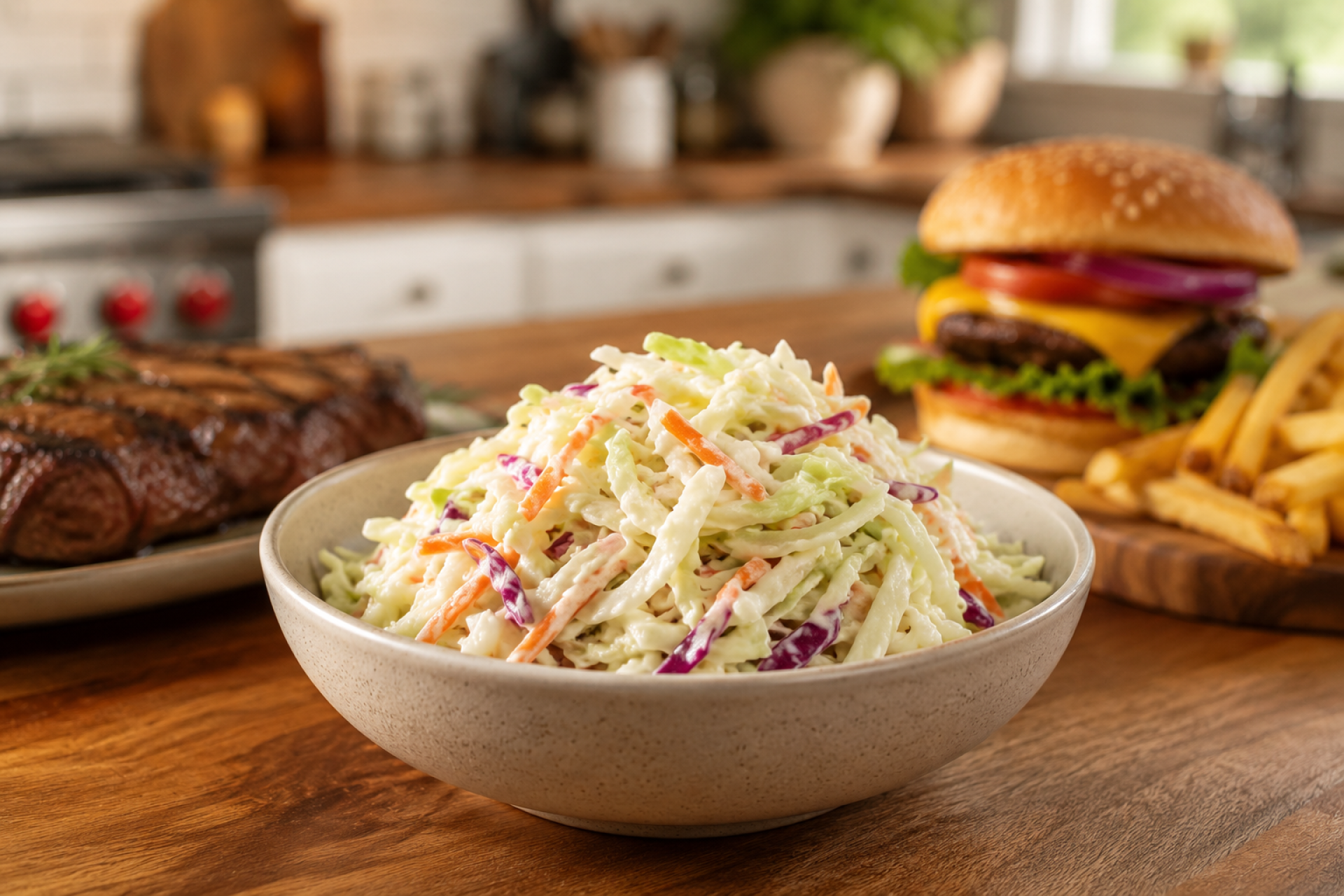
Coleslaw is a shredded cabbage salad tossed with a variety of dressings, ranging from rich and creamy mayonnaise-based sauces to lighter dressings in which vinegar is the main ingredient. It is generally served chilled as a refreshing side dish that helps balance the richness of heavier foods, particularly fried and grilled dishes such as fried chicken, steak, and hamburgers.
During this period, an influential cookbook known as De Verstandige Kock was published in 1667. The book brought together cooking methods and ingredient preparations that reflected the lifestyles of Dutch households at the time, particularly those of the middle and upper classes. Among its recipes was a preparation in which finely shredded cabbage was combined with butter, vinegar, and oil.
The Dutch referred to this type of cabbage salad as “Koolsla.” The word was derived from “kool,” meaning cabbage, and “sla,” a shortened form of the Dutch word for salad. Together, “Koolsla” literally means “cabbage salad.”
As the term Koolsla entered English-speaking society, its pronunciation and spelling gradually adapted to the English language. The expression “cole slaw” emerged, eventually developing into the single-word form “Coleslaw,” which is now widely used around the world.
One of the figures who played an important role in making mayonnaise widely popular in the United States was Richard Hellmann, a German immigrant who opened a delicatessen with his wife in New York City in the early 20th century. Richard began selling his own mayonnaise recipe, which quickly became popular with customers. He subsequently expanded production and began selling the product commercially in jars in 1912 under the name “Hellmann’s Blue Ribbon Mayonnaise.”
The increasing availability of commercially produced mayonnaise gradually influenced the way Coleslaw was prepared in American kitchens. Mayonnaise provided a rich, creamy texture while also allowing shredded cabbage to absorb and carry the flavors of the dressing. Over time, mayonnaise-based Coleslaw became particularly associated with American cuisine, although vinegar-based versions continued to remain popular in many regions.
In the United States, Coleslaw became especially popular as an accompaniment to barbecue and fried foods. Its cool, crisp texture and slightly acidic flavor provided a refreshing contrast to rich, smoky, and savory dishes. This made it a natural companion to American barbecue, fried chicken, burgers, sandwiches, and other hearty foods.
Regional variations also emerged as Coleslaw spread throughout the country. Some recipes emphasized creamy mayonnaise-based dressings, while others relied on vinegar, mustard, sugar, or other seasonings. The choice of cabbage and additional ingredients also varied, with carrots, onions, apples, celery, and other vegetables sometimes added to create different textures and flavors.
Today, Coleslaw is no longer limited to Dutch or American cuisine. It has become a familiar side dish in many countries, where local ingredients and culinary traditions have influenced its preparation. Some versions remain close to the classic combination of cabbage and dressing, while others incorporate fruits, herbs, spices, or regional sauces.
Despite these variations, the fundamental character of Coleslaw remains remarkably consistent: fresh shredded vegetables combined with a flavorful dressing to create a dish that is crisp, refreshing, and versatile.
The history of Coleslaw therefore illustrates how a seemingly simple dish can travel across borders and transform over time. From the cabbage preparations of ancient Europe, to Koolsla in the Netherlands, and eventually to the creamy American Coleslaw served alongside barbecue and fried foods, its evolution reflects centuries of migration, cultural exchange, and culinary innovation.
What began as a practical way of preparing an abundant and inexpensive vegetable ultimately became one of the world's most recognizable side dishes. Today, Coleslaw continues to evolve while retaining its connection to its Dutch origins, serving as a reminder that culinary traditions are rarely static. They change as people move, ingredients become available, and cultures interact—allowing simple foods to acquire new identities while carrying traces of their history with them.
This style of Coleslaw produced a noticeably different result from traditional cabbage salads that primarily relied on oil, vinegar, or butter. Mayonnaise coated the shredded cabbage, giving it a softer and richer texture while adding creaminess, richness, and greater depth to the overall flavor.
This transformation marked another important chapter in the history of Coleslaw. What had originally been a simple cabbage salad rooted in Dutch culinary culture gradually evolved in response to the ingredients, food production technologies, and changing tastes of American consumers, eventually giving rise to what is now recognized as American-style Coleslaw.
However, there is no single definitive recipe for Coleslaw, and the growing popularity of mayonnaise did not cause vinegar-based versions to disappear. Instead, both styles continued to coexist, while numerous regional variations emerged around the world, each reflecting the local ingredients and culinary traditions of its respective culture.
Regional Styles in the United States United States: In addition to mayonnaise-based Coleslaw, the southern United States—particularly North Carolina—is home to a distinctive variation known as “Lexington Red Slaw” or “Barbecue Slaw.” Unlike creamy Coleslaw, this version contains no mayonnaise and instead relies primarily on vinegar, ketchup, and black pepper. It is traditionally served alongside barbecue, where its acidity helps balance the richness of smoked and grilled meats. In areas around Pennsylvania, another variation known as “Pennsylvania Dutch Pepper Slaw” can be found. This version combines cabbage with bell peppers and is seasoned with mustard and celery seeds, creating a crisp and slightly tangy accompaniment.
European Cabbage Salads Europe: In Germany, a cabbage salad known as “Krautsalat” is commonly prepared with vegetable oil and vinegar, and some variations include bacon. It can be served either warm or cold, depending on the regional tradition and preparation. In Sweden, “Pizza Salad” is a popular cabbage-based side dish commonly served at pizzerias. It is typically prepared with vinegar and black pepper and is considered a characteristic accompaniment to Swedish-style pizza.
Latin American Interpretations Latin America: In Mexico, a cabbage salad known as “Ensalada de col” is often seasoned with lime juice or prepared with mayonnaise blended with Chipotle peppers and oregano. It is commonly served alongside fish tacos, where its fresh and tangy character provides a contrast to the richness of the filling. In El Salvador, “Curtido” is a fermented cabbage salad made with cabbage, carrots, and onions, seasoned with vinegar and oregano. It is traditionally served alongside Pupusas, one of the country's most iconic foods.
Middle Eastern Variations Middle East: In Turkey, a cabbage salad known as “Lahana Salatası” combines shredded cabbage with grated carrots and is commonly seasoned with lemon juice and vegetable oil. Some variations use thick yogurt instead of mayonnaise, creating a creamy texture while providing a lighter alternative to traditional mayonnaise-based Coleslaw.
Ancient Roman Roots: The Early Cabbage Salads
Although the word “Coleslaw” did not appear until the late 18th century, the idea of shredding cabbage, seasoning it, and serving it as a side dish dates back many centuries. Evidence of similar cabbage preparations can be found in the writings of Apicius, an important culinary text from ancient Rome. Among the recipes described are preparations in which cabbage was combined with ingredients such as oil, stock, cumin, pepper, leek, and fresh coriander.The Dutch Golden Age and the Birth of “Koolsla”
However, a dish more closely resembling the Coleslaw we know today emerged in the Netherlands during the Dutch Golden Age, a period when the country experienced remarkable prosperity in trade, commerce, maritime exploration, science, and the culinary arts.During this period, an influential cookbook known as De Verstandige Kock was published in 1667. The book brought together cooking methods and ingredient preparations that reflected the lifestyles of Dutch households at the time, particularly those of the middle and upper classes. Among its recipes was a preparation in which finely shredded cabbage was combined with butter, vinegar, and oil.
The Dutch referred to this type of cabbage salad as “Koolsla.” The word was derived from “kool,” meaning cabbage, and “sla,” a shortened form of the Dutch word for salad. Together, “Koolsla” literally means “cabbage salad.”
Crossing the Atlantic: How Koolsla Became Coleslaw
During the 17th century, Dutch settlers migrated to North America and established the colony of New Netherland. Along with their language and traditions, they brought their culinary customs and recipes from Europe. Among the foods that crossed the Atlantic with these Dutch communities was Koolsla.As the term Koolsla entered English-speaking society, its pronunciation and spelling gradually adapted to the English language. The expression “cole slaw” emerged, eventually developing into the single-word form “Coleslaw,” which is now widely used around the world.
The Mayonnaise Revolution and Richard Hellmann
A major turning point in the evolution of Coleslaw into the creamy dish familiar today was the growing popularity of mayonnaise.One of the figures who played an important role in making mayonnaise widely popular in the United States was Richard Hellmann, a German immigrant who opened a delicatessen with his wife in New York City in the early 20th century. Richard began selling his own mayonnaise recipe, which quickly became popular with customers. He subsequently expanded production and began selling the product commercially in jars in 1912 under the name “Hellmann’s Blue Ribbon Mayonnaise.”
The increasing availability of commercially produced mayonnaise gradually influenced the way Coleslaw was prepared in American kitchens. Mayonnaise provided a rich, creamy texture while also allowing shredded cabbage to absorb and carry the flavors of the dressing. Over time, mayonnaise-based Coleslaw became particularly associated with American cuisine, although vinegar-based versions continued to remain popular in many regions.
A Perfect Pairing for American Barbecue and Beyond
The transformation of Coleslaw from a simple Dutch cabbage salad into a familiar American side dish reflects the broader history of food migration and cultural exchange. A recipe that originated in Europe traveled across the Atlantic with Dutch settlers, adapted to a new environment, and eventually evolved alongside American culinary traditions.In the United States, Coleslaw became especially popular as an accompaniment to barbecue and fried foods. Its cool, crisp texture and slightly acidic flavor provided a refreshing contrast to rich, smoky, and savory dishes. This made it a natural companion to American barbecue, fried chicken, burgers, sandwiches, and other hearty foods.
Regional variations also emerged as Coleslaw spread throughout the country. Some recipes emphasized creamy mayonnaise-based dressings, while others relied on vinegar, mustard, sugar, or other seasonings. The choice of cabbage and additional ingredients also varied, with carrots, onions, apples, celery, and other vegetables sometimes added to create different textures and flavors.
Today, Coleslaw is no longer limited to Dutch or American cuisine. It has become a familiar side dish in many countries, where local ingredients and culinary traditions have influenced its preparation. Some versions remain close to the classic combination of cabbage and dressing, while others incorporate fruits, herbs, spices, or regional sauces.
Despite these variations, the fundamental character of Coleslaw remains remarkably consistent: fresh shredded vegetables combined with a flavorful dressing to create a dish that is crisp, refreshing, and versatile.
The history of Coleslaw therefore illustrates how a seemingly simple dish can travel across borders and transform over time. From the cabbage preparations of ancient Europe, to Koolsla in the Netherlands, and eventually to the creamy American Coleslaw served alongside barbecue and fried foods, its evolution reflects centuries of migration, cultural exchange, and culinary innovation.
What began as a practical way of preparing an abundant and inexpensive vegetable ultimately became one of the world's most recognizable side dishes. Today, Coleslaw continues to evolve while retaining its connection to its Dutch origins, serving as a reminder that culinary traditions are rarely static. They change as people move, ingredients become available, and cultures interact—allowing simple foods to acquire new identities while carrying traces of their history with them.
The Birth of American-Style Creamy Coleslaw
As mayonnaise became increasingly popular, the preparation of Coleslaw in the United States gradually evolved. New recipes began combining finely shredded cabbage with mayonnaise, along with sugar, vinegar, and other seasonings to create a more balanced flavor profile.This style of Coleslaw produced a noticeably different result from traditional cabbage salads that primarily relied on oil, vinegar, or butter. Mayonnaise coated the shredded cabbage, giving it a softer and richer texture while adding creaminess, richness, and greater depth to the overall flavor.
This transformation marked another important chapter in the history of Coleslaw. What had originally been a simple cabbage salad rooted in Dutch culinary culture gradually evolved in response to the ingredients, food production technologies, and changing tastes of American consumers, eventually giving rise to what is now recognized as American-style Coleslaw.
However, there is no single definitive recipe for Coleslaw, and the growing popularity of mayonnaise did not cause vinegar-based versions to disappear. Instead, both styles continued to coexist, while numerous regional variations emerged around the world, each reflecting the local ingredients and culinary traditions of its respective culture.
Global Variations of Cabbage Salad
Regional Styles in the United States United States: In addition to mayonnaise-based Coleslaw, the southern United States—particularly North Carolina—is home to a distinctive variation known as “Lexington Red Slaw” or “Barbecue Slaw.” Unlike creamy Coleslaw, this version contains no mayonnaise and instead relies primarily on vinegar, ketchup, and black pepper. It is traditionally served alongside barbecue, where its acidity helps balance the richness of smoked and grilled meats. In areas around Pennsylvania, another variation known as “Pennsylvania Dutch Pepper Slaw” can be found. This version combines cabbage with bell peppers and is seasoned with mustard and celery seeds, creating a crisp and slightly tangy accompaniment.
European Cabbage Salads Europe: In Germany, a cabbage salad known as “Krautsalat” is commonly prepared with vegetable oil and vinegar, and some variations include bacon. It can be served either warm or cold, depending on the regional tradition and preparation. In Sweden, “Pizza Salad” is a popular cabbage-based side dish commonly served at pizzerias. It is typically prepared with vinegar and black pepper and is considered a characteristic accompaniment to Swedish-style pizza.
Latin American Interpretations Latin America: In Mexico, a cabbage salad known as “Ensalada de col” is often seasoned with lime juice or prepared with mayonnaise blended with Chipotle peppers and oregano. It is commonly served alongside fish tacos, where its fresh and tangy character provides a contrast to the richness of the filling. In El Salvador, “Curtido” is a fermented cabbage salad made with cabbage, carrots, and onions, seasoned with vinegar and oregano. It is traditionally served alongside Pupusas, one of the country's most iconic foods.
Middle Eastern Variations Middle East: In Turkey, a cabbage salad known as “Lahana Salatası” combines shredded cabbage with grated carrots and is commonly seasoned with lemon juice and vegetable oil. Some variations use thick yogurt instead of mayonnaise, creating a creamy texture while providing a lighter alternative to traditional mayonnaise-based Coleslaw.
Tags :
Related Content