Croûton
Last updated: 3 Sept 2026
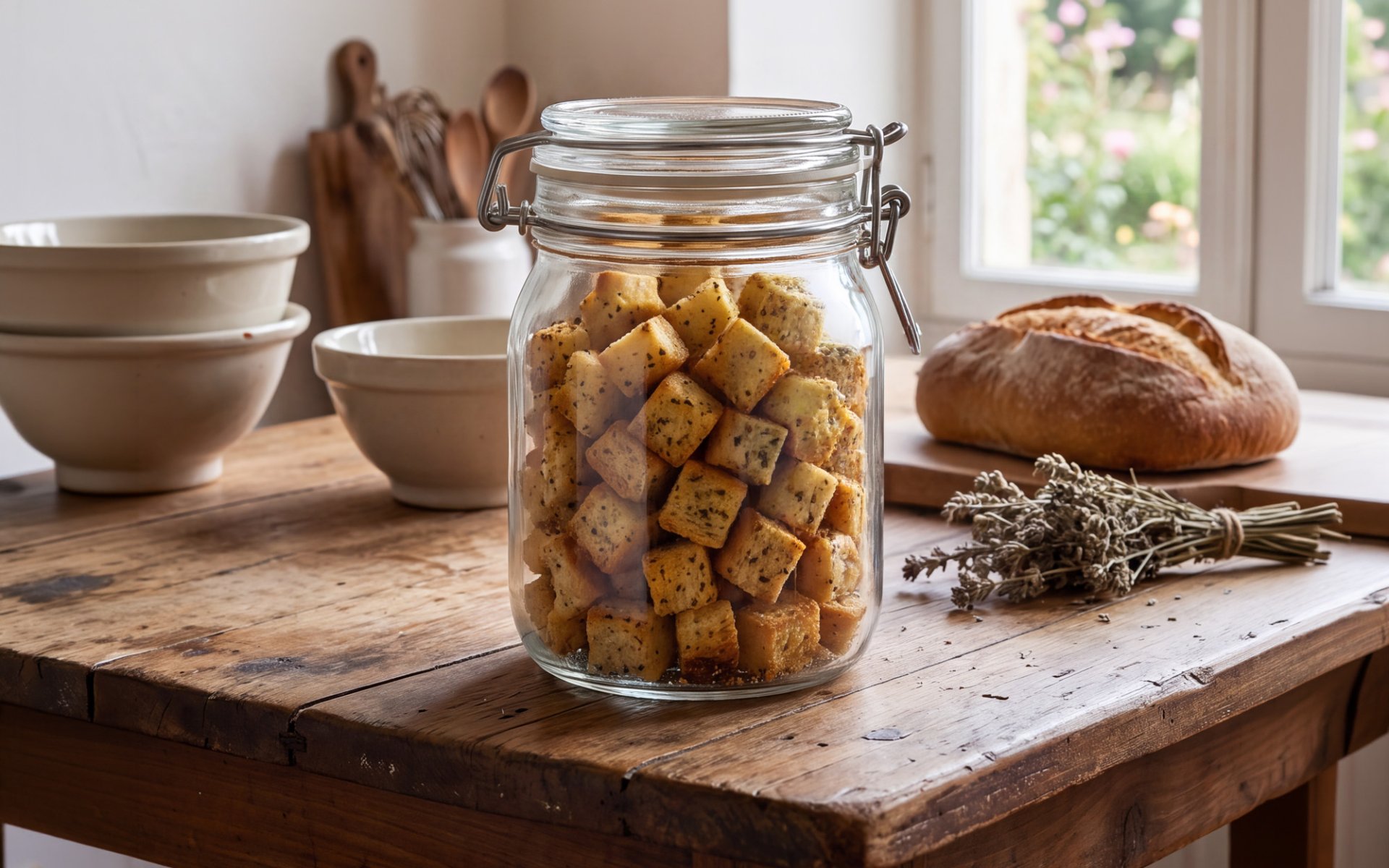
Croûton is a small piece of bread that is baked or fried until crisp. It is commonly cut into cubes or bite-sized pieces and seasoned with various ingredients such as herbs, olive oil, or butter. Croûtons are used in a wide range of dishes, particularly as toppings for salads, soups, and stews, where they add crispness and another layer of texture to the dish.
The word “Croûton” originates from the French language and is the diminutive form of “Croûte,” meaning “bread crust.” The word “Croûte” itself can be traced back to the Latin word “Crusta,” meaning a hard outer layer or crust. In French dictionaries, the term “Croûton” began appearing in the 17th century and was used to describe small pieces of bread that were typically baked or fried until crisp before being served with food.
At a time when preparing food required considerable labor and resources, throwing food away was undesirable for both economic and social reasons. People therefore sought ways to make use of stale bread. One common approach was to soak bread in liquids such as water, wine, olive oil, or broth, allowing it to absorb moisture and become soft enough to eat again.
During the European Middle Ages, dining practices among the upper classes gave rise to another interesting use of bread: the “Trencher.” A trencher was a thick slice of bread that could serve as a substitute for a plate in certain contexts. Because eating vessels made from metal or other materials were relatively expensive and not always readily available, dense bread was sometimes cut into thick slices and used to hold food, particularly meat and dishes served with sauces.
During the meal, the bread absorbed sauces and fats from the food, changing both its flavor and texture. At the end of the meal, the bread used as a trencher could be collected and given to servants, retainers, or people in need. They could then boil the trenchers together with vegetables and broth, allowing the bread to soften and become edible once again. Over time, these practices contributed to the broader European tradition of eating bread together with soups and other liquid-based dishes. They also formed part of the cultural foundation for using bread as an ingredient or accompaniment in cooked and prepared foods.
During this period, the use of bread in French cuisine became increasingly diverse. French cooks began finding more sophisticated ways to make use of stale bread. Instead of placing bread directly into soup, they increasingly cut it into specific shapes and sizes, such as cubes or thin slices, and then fried or baked it until dry and crisp.
This process not only provided an effective way to reuse stale bread but also transformed its color, aroma, and flavor through exposure to heat. In particular, the Maillard reaction contributed to the development of a golden-brown surface and a more pronounced roasted aroma. Once bread had been prepared to become crisp and retain its shape, it could be used as an ingredient or accompaniment to a dish. Its crunchy texture provided a contrast to softer components, creating greater textural variety within the meal. It was during this period that the term “Croûton” came into use to describe small pieces of bread that were typically baked or fried until crisp before being served alongside other foods.
Escoffier categorized croûtons according to their intended use. These included:
Today, Croûton has spread into culinary cultures across many regions of the world. Its preparation and flavor have also been adapted to suit local ingredients and tastes. For example, Pumpernickel, a dense, dark German rye bread, can be transformed into croûtons and served with salads. In other countries, locally produced breads are similarly adapted to create croûtons that reflect the culinary traditions and ingredients of their respective regions.
Beyond their use as components of salads and soups, croûtons have also evolved into snacks that can be eaten on their own. They are now available in a wide variety of flavors, ranging from garlic and herbs to cheese and different spices.
From its humble origins as a practical way to make use of leftover or stale bread, Croûton has evolved into a versatile element of modern cuisine. Its enduring popularity demonstrates how a simple culinary practice rooted in resourcefulness can develop into an important part of food culture, while continuing to adapt to changing tastes and culinary traditions.
The word “Croûton” originates from the French language and is the diminutive form of “Croûte,” meaning “bread crust.” The word “Croûte” itself can be traced back to the Latin word “Crusta,” meaning a hard outer layer or crust. In French dictionaries, the term “Croûton” began appearing in the 17th century and was used to describe small pieces of bread that were typically baked or fried until crisp before being served with food.
The Problem of Stale Bread and the Medieval "Trencher"
Bread has been a staple food in Western civilizations since ancient Egypt, Greece, and Rome. However, bread during these periods was quite different from the bread we know today, particularly in terms of texture and shelf life. As bread was left for longer periods, changes occurred within the starch structure, causing it to lose its softness and become increasingly firm and stale.At a time when preparing food required considerable labor and resources, throwing food away was undesirable for both economic and social reasons. People therefore sought ways to make use of stale bread. One common approach was to soak bread in liquids such as water, wine, olive oil, or broth, allowing it to absorb moisture and become soft enough to eat again.
During the European Middle Ages, dining practices among the upper classes gave rise to another interesting use of bread: the “Trencher.” A trencher was a thick slice of bread that could serve as a substitute for a plate in certain contexts. Because eating vessels made from metal or other materials were relatively expensive and not always readily available, dense bread was sometimes cut into thick slices and used to hold food, particularly meat and dishes served with sauces.
During the meal, the bread absorbed sauces and fats from the food, changing both its flavor and texture. At the end of the meal, the bread used as a trencher could be collected and given to servants, retainers, or people in need. They could then boil the trenchers together with vegetables and broth, allowing the bread to soften and become edible once again. Over time, these practices contributed to the broader European tradition of eating bread together with soups and other liquid-based dishes. They also formed part of the cultural foundation for using bread as an ingredient or accompaniment in cooked and prepared foods.
The 17th Century: Haute Cuisine and the Birth of the Croûton
A significant development in the use of bread in French cuisine took place during the 17th century, when ideas surrounding Haute Cuisine, or high cuisine, began to become more clearly established. One of the influential figures of this period was François Pierre de La Varenne, a French chef and cookbook author whose important work, Le Cuisinier François, was published in 1651.During this period, the use of bread in French cuisine became increasingly diverse. French cooks began finding more sophisticated ways to make use of stale bread. Instead of placing bread directly into soup, they increasingly cut it into specific shapes and sizes, such as cubes or thin slices, and then fried or baked it until dry and crisp.
This process not only provided an effective way to reuse stale bread but also transformed its color, aroma, and flavor through exposure to heat. In particular, the Maillard reaction contributed to the development of a golden-brown surface and a more pronounced roasted aroma. Once bread had been prepared to become crisp and retain its shape, it could be used as an ingredient or accompaniment to a dish. Its crunchy texture provided a contrast to softer components, creating greater textural variety within the meal. It was during this period that the term “Croûton” came into use to describe small pieces of bread that were typically baked or fried until crisp before being served alongside other foods.
Auguste Escoffier and the Systematization of Croûtons
By the 19th century, Auguste Escoffier, the renowned French chef who played a major role in shaping the organization and principles of modern French cuisine, contributed significantly to the systematization of Western culinary practices. In his influential work, Le Guide Culinaire, he described methods for preparing croûtons as well as different ways of incorporating them into dishes.Escoffier categorized croûtons according to their intended use. These included:
- Small croûtons used as toppings for clear soups.
- Triangular pieces fried in butter to accompany or garnish meat dishes.
- Croûtons seasoned with herbs and garlic to enhance their aroma and flavor.
Global Popularity: The Caesar Salad and Modern Snacking
Although Croûton has its roots in European culinary culture, its transformation into an ingredient widely recognized and enjoyed around the world was influenced in part by its growing popularity in North America during the early 20th century, particularly through the rise of the Caesar Salad. The Caesar Salad helped introduce crisp bread cubes to a much wider audience, establishing croûtons as a familiar component of salads and contributing to their popularity beyond the traditions of French cuisine.Today, Croûton has spread into culinary cultures across many regions of the world. Its preparation and flavor have also been adapted to suit local ingredients and tastes. For example, Pumpernickel, a dense, dark German rye bread, can be transformed into croûtons and served with salads. In other countries, locally produced breads are similarly adapted to create croûtons that reflect the culinary traditions and ingredients of their respective regions.
Beyond their use as components of salads and soups, croûtons have also evolved into snacks that can be eaten on their own. They are now available in a wide variety of flavors, ranging from garlic and herbs to cheese and different spices.
From its humble origins as a practical way to make use of leftover or stale bread, Croûton has evolved into a versatile element of modern cuisine. Its enduring popularity demonstrates how a simple culinary practice rooted in resourcefulness can develop into an important part of food culture, while continuing to adapt to changing tastes and culinary traditions.
Tags :
Related Content



Getting to Know “Salmon Terrine” – A Refined French Dish that Blends Elegance with the Flavors of the Sea