Morbier
Last updated: 19 Feb 2026
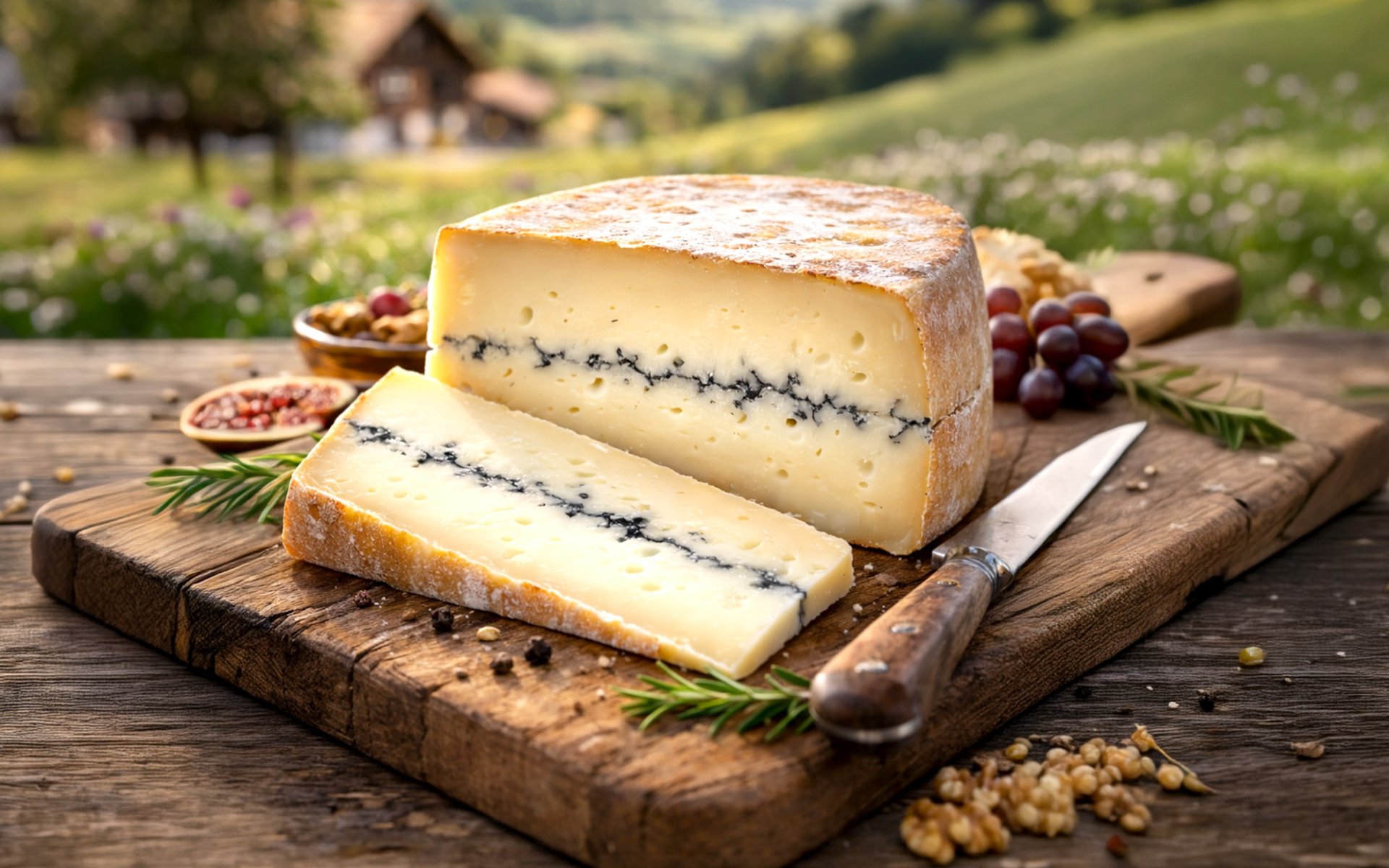
“Morbier” is a type of cheese from France. It has a firm brown rind and a dense interior without holes, distinguished by a thin black layer running horizontally through the center of the cheese. Morbier is classified as a “Fromage à pâte pressée non cuite” (uncooked pressed cheese). It is produced by taking raw milk that has been curdled (using rennet or enzymes to coagulate the milk into curds) and pressing it to expel as much whey as possible before aging it into cheese. This process results in a particularly dense texture.
The Origin of the Name and 18th-Century Roots
The name “Morbier” was derived from a village in the Jura Mountains of the Bourgogne-Franche-Comté region in France. The name first appeared in written records in 1789, leading to the assumption that this cheese originated in the 18th century. Prior to that time, the cheese most commonly produced in the Jura Mountains and the region was “Comté,” whose production methods had been developed over thousands of years.Connection to Comté Cheese Tradition
In the tradition of making Comté cheese, dairy farmers were required to deliver raw milk to village cheese dairies immediately after milking. Comté was often produced for sale to the upper classes. Because the Jura region is mountainous, the weather was frequently harsh, particularly in winter. Not only was transportation difficult, but milk production was often insufficient for making Comté. As a result, farmers needed to use the milk they had available to create a new type of cheese for their own consumption.The Origin of Morbier’s Signature Black Line
They began by taking the curds from the evening milking, which were produced in smaller quantities, and placing them into a mold until it was about halfway full. They then covered the top of the curd with ash powder obtained from cooking pots and pans to protect it from insects and mold. This practice is the origin of the distinctive black line that gives Morbier its unique identity. The following morning, after milking and delivering milk for Comté production, the remaining milk was curdled again and poured over the previous layer to fill the mold completely before being pressed and aged. A thick wheel of cheese such as this also had a longer shelf life.Spread of Production and Post-War Recognition
The production method of Morbier gradually spread across several areas of Bourgogne-Franche-Comté, particularly Jura, Ain, Doubs, and Saône-et-Loire, eventually becoming a renowned cheese of these regions. After World War II, Morbier was discovered for the first time by people outside the region. This was partly due to the presence of the École Nationale de l’Industrie Laitière (ENIL), a national dairy industry school located in Poligny in the Jura department, which attracted students from many parts of France. Because of the cheese’s distinctive character, many graduates later went on to produce Morbier in other regions.Protection of Authentic Morbier: AOC and PDO
However, Morbier produced outside the original region often involved adapted production methods for convenience, particularly the use of pasteurized milk, which removed one of the most important characteristics of this cheese. Producers in the traditional region therefore established the label “the Véritable Morbier de Franche-Comté” to identify cheese that was correctly produced according to traditional methods in Jura, Ain, Doubs, and Saône-et-Loire. In 2000, Morbier cheese was granted Appellation d’Origine Contrôlée (AOC) status, the French geographical indication certification. It later also received Protected Designation of Origin (PDO) status from the European Union.PDO Regulations: Cattle Breeds and Farming Standards
Beyond the designated production area, the PDO specifications for Morbier also cover the breeds and husbandry of the cows whose milk is used. Only local breeds such as Montbéliarde, French Simmental, and crossbreeds between these two are permitted. Each cow must have at least 10,000 square meters of grazing area. The emphasis is on natural pasture feeding, where at least three types of plants must be available for consumption, including grasses and legumes with restricted fertilizer use. The use of fermented plant feed (silage) is prohibited.Flavor Profile and Aging Characteristics
Although Morbier is classified as a washed-rind cheese—its rind being washed with brine to encourage the growth of bacteria that create the brown exterior—it does not have a strong odor, nor is it very salty. Because it is made from raw milk, it retains the aroma of fresh milk very clearly, especially when aged for a shorter period of 45–60 days. When aged longer, up to 90 days, it develops a fresh fruity character combined with notes of vanilla and caramel. Today, the ash used in production is food-safe vegetable charcoal.Pairing and Culinary Uses
With its approachable flavor, Morbier pairs well with a variety of beverages and accompaniments, particularly beer, Chardonnay wine from Jura, apples, and tea. In addition to being enjoyed fresh, Morbier melts when heated and can therefore be used in many dishes, especially baked recipes such as Croque-Monsieur (French-style baked sandwich), pizza, muffins, and Tartiflette (cheese baked with potatoes and bacon). Tags :
Related Content