Dessert with Dairy
Last updated: 24 Mar 2026
Overview of Dairy Desserts in Modern Times
Today, desserts and sweets made with milk and dairy products are widely found around the world. In fact, the use of milk and dairy ingredients in desserts has a long history and has evolved over time across different cultures in every corner of the globe.Origins of Sweet-Making in Early Civilizations
Since the earliest days of human civilization, the creation of sweets and desserts has developed alongside it. Early recipes often relied on ingredients such as legumes and grains, with sweetness derived from fruits and honey. Of course, animal milk—consumed since prehistoric times—was also an essential component. Archaeological evidence has revealed desserts made by heating milk in ancient civilizations such as Egypt, Rome, and China, which are believed to have resembled early forms of pudding or custard.Greco-Roman Custard Foundations
The custards of the Greco-Roman period (332 BC – AD 642) can be considered the foundation of custard and pudding desserts in Europe. During the Roman era, simple ingredients such as milk, eggs, and natural sweeteners—especially honey—were heated together until thickened. Initially, these preparations were created purely as energy-providing foods. The ancient Romans also developed a dessert called “Tiropatina,” or baked custard, which is regarded as an ancestor of the popular caramel custard desserts known today as flan or crème caramel. Over time, this simple preparation evolved into a wide variety of milk-based desserts across Europe.Middle Eastern Influence on Dairy Desserts
In the Middle East, there are also ancient milk-based desserts, among which “Muhallebi” is considered one of the oldest. It originated around the 7th century among Persians during the Sasanian Empire. This milk pudding is made from milk, flour, and sugar, and is often flavored with rose water. Muhallebi played a significant role in spreading the concept of milk-based desserts to other regions, particularly through trade with Europe during the Middle Ages. Its influence led to adaptations in European cuisine, especially in desserts associated with the upper class and luxurious dining, such as Blancmange—a medieval milk-based dessert with a jelly-like texture. This period also coincided with the increasing use of sugar and spices in confectionery. Other similar desserts include Egypt’s Roz Bel Laban (rice pudding) and Turkey’s Sütlaç, both of which combine milk with starch or grains to create a rich and filling texture, much like Muhallebi.Development of Milk Desserts in Asia
Across Asia, milk-based desserts developed in ways that clearly reflect local ingredients and culinary traditions. For example, in Shawan, an ancient town in Guangdong Province dating back to around the 13th century, a dessert called “Jiang Zhi Zhuang Nai” (Ginger Milk Curd) was created using the natural reaction between milk and ginger juice to produce a custard-like texture. Additionally, the earliest form of ice cream is believed to have originated in China around 4,000 years ago, when ancient people combined crushed natural ice with milk and fruits. Later, during the Tang Dynasty (AD 618–907), further developments included heating buffalo or goat milk and allowing it to ferment in a process similar to yogurt-making, then mixing it with flour to achieve a smooth texture and adding camphor for a cooling fragrance. The mixture was then frozen using ice or snow. This method of making ice cream was later introduced to Italy in the 13th century by the explorer Marco Polo and subsequently spread throughout European royal courts, eventually becoming one of the most popular desserts worldwide today.Early Modern Dessert Documentation and Innovations
As the world entered the early modern period (from the 16th century onward), recipes for desserts began to be clearly documented and widely distributed through printed media. In Scandinavia, a well-known dessert called “Kalvdans” emerged from the practice of farmers boiling colostrum—the first milk produced by cows or goats after giving birth. Colostrum contains a higher protein content than regular milk and solidifies when heated, resulting in a texture similar to pudding. In China, another innovation appeared during the Qing Dynasty (AD 1636–1912) with “Shuang Pi Nai” (Double Skin Milk), which was developed through food preservation techniques that carefully control temperature and the layering of milk to achieve a delicate and uniquely smooth texture.Role of Cream in Dessert Development
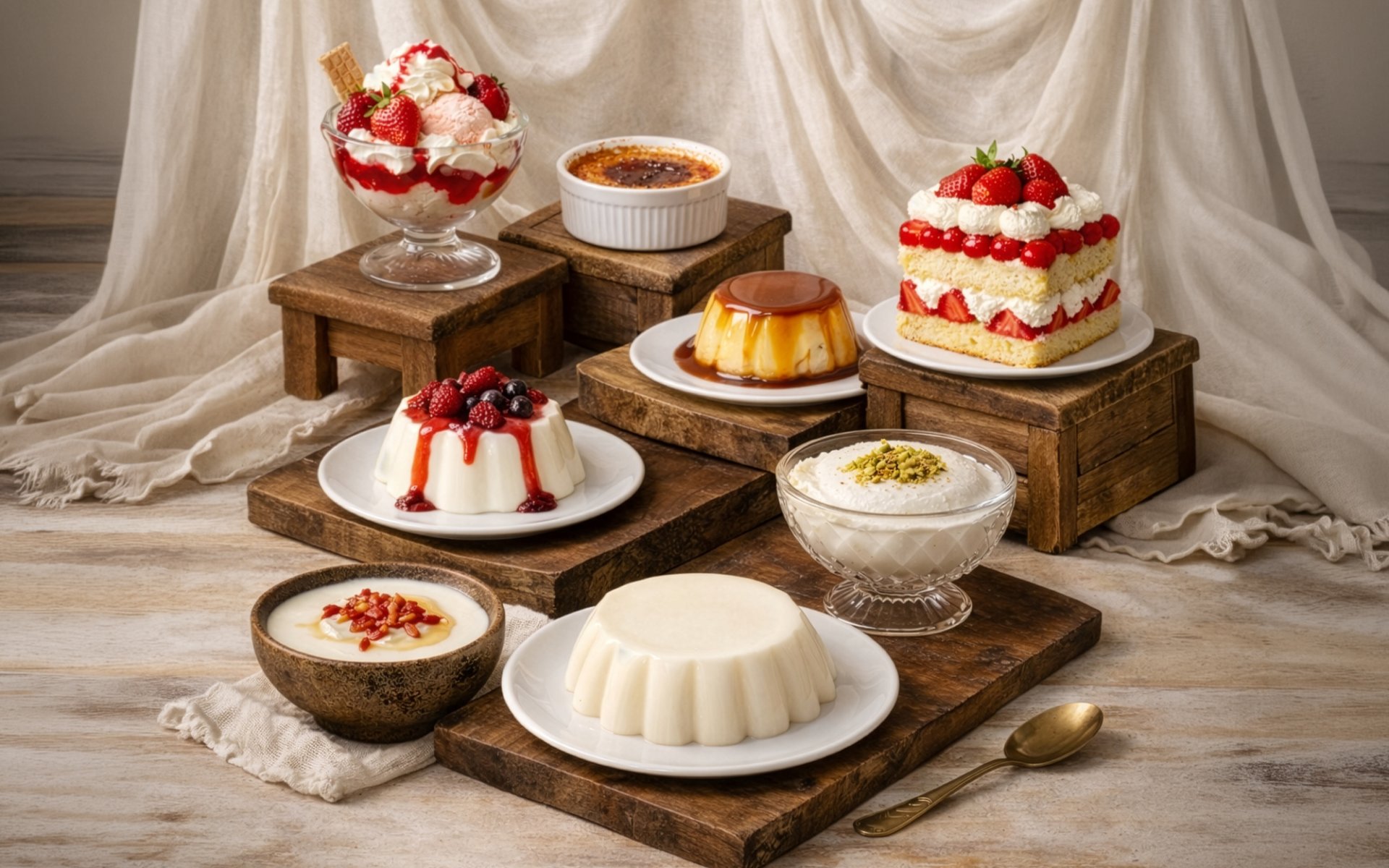
Another key component that has played a major role in the development of milk-based desserts is “cream,” which is the high-fat portion of milk separated for culinary use. The use of cream in desserts became particularly widespread in Europe, especially with the invention of Chantilly cream in the 17th century. As technologies for separating milk fat improved, cream was increasingly used to enhance richness, create smooth and velvety textures, and add depth of flavor to desserts, as well as to decorate items such as pies and cakes. There are also many desserts in which cream serves as a primary ingredient, such as Crème brûlée and Panna cotta, both of which are rooted in the custard traditions of the Greco-Roman era.Milk Desserts in South and Southeast Asia
Meanwhile, in South Asia and Southeast Asia, traditional desserts often relied on plant-based milk, particularly coconut milk, combined with palm sugar, local fruits, and spices. This resulted in desserts with complex flavors and distinctive aromas. However, with the influence of dairy consumption from the Middle East and the West, along with the introduction of products such as evaporated milk and condensed milk, more desserts began to incorporate cow’s milk. Examples include Sri Lanka’s Watalappam, a custard-like dessert made with cashews, eggs, and spices, and Vietnamese Sữa Chua, a yogurt made from fresh milk combined with sweetened condensed milk.Industrial Era and Globalization of Dairy Desserts
With the arrival of the industrial era, new ingredients capable of creating diverse textures became more widely available, such as cornstarch and gelatin. Dairy products used in dessert-making also expanded to include pasteurized milk, condensed milk, and milk powder. As a result, ready-made desserts could be produced on an industrial scale and consumed globally. Milk-based desserts in the modern era are no longer limited to traditional recipes from specific regions but have become globally diverse, blending techniques, ingredients, and tastes from multiple cultures into harmonious creations. Tags :