Airborne Honey
In its early years, beekeeping was far from easy. Modern agricultural technology and honey-processing equipment were not yet available, so transporting beehives relied on horse- or ox-drawn wagons and manual labor. William and Alfred devoted countless hours to carefully managing their colonies and harvesting honey with exceptional dedication.
Innovative Marketing in the Early 20th Century
During the early 20th century, honey was not yet widely recognized in New Zealand as a nutritious health food. One reason was that honey products were often marketed in unattractive packaging, making them less appealing to consumers. Recognizing this challenge, William and Alfred set out to educate the public about the nutritional benefits of honey.They adopted marketing strategies that were remarkably innovative for their time. These included offering free honey tastings on crackers at trade fairs, creating attractive in-store displays to increase product visibility, giving educational talks in schools about the health benefits of honey, and publishing cookbooks featuring recipes made with honey.
These efforts played a significant role in changing consumer perceptions, helping honey gradually become a staple ingredient in New Zealand households.
The Birth of Airborne and a New Era
As the business expanded during the late 1920s, the company relocated its operations from the coastal areas of Banks Peninsula to Leeston, a small town in the Canterbury region. The new location offered an ideal environment for establishing honey processing and packaging facilities, along with improved transportation and distribution networks.Around the same time, the company officially registered two primary honey trademarks: Meadow, representing light amber honey, and Airborne, developed specifically for White Clover Honey, known for its light color, smooth texture, and delicate flavor.
The Airborne brand steadily gained popularity and eventually became the company's flagship product. Its most significant period of growth came under the leadership of the third generation of the Bray family, Peter Bray, William’s grandson.
A Shift to Technology and Innovation
Unlike his grandfather and father, Peter was less interested in spending his days working among the beehives. Instead, he possessed a strong passion for analytical science and innovation. After graduating from the Queensland Agricultural College in Australia, he returned to New Zealand to continue the family business, focusing primarily on honey processing, quality control, and marketing.Throughout the late 1980s and 1990s, the company expanded rapidly, increasing its beehive population to approximately 4,000–6,000 hives, demonstrating its growing industrial-scale production capabilities.
A major turning point came in 1997, when Peter made the bold decision to sell all of the company’s beehives. Rather than producing honey themselves, Airborne shifted its business model to become a leader in honey technology and innovation. The company began sourcing raw honey directly from beekeepers across New Zealand, providing them with a stable source of income while allowing Airborne to focus on rigorous laboratory testing, quality assurance, and premium packaging.
Even before this transition, Peter had already established an in-house laboratory during the 1980s. What began with a single microscope and a small workbench has since evolved into one of New Zealand’s most advanced honey analysis laboratories. Today, the laboratory houses a comparative database containing over 40,000 honey samples and is one of the few private laboratories in New Zealand equipped with Evaporative Light Scattering Detection (ELSD) technology, enabling highly detailed analysis of honey sugar profiles.
What Makes Airborne Honey Different?
Airborne distinguishes itself through its unwavering commitment to preserving the natural purity of honey while adhering to the internationally recognized Codex Alimentarius food standards.
Complete Traceability with TraceMe : Every jar of Airborne Honey features a transparent traceability system called TraceMe. By entering the batch code, consumers can access detailed information about the honey, including the apiaries that contributed to the batch, every storage tank involved, laboratory testing results, transportation history from harvest to bottling, and even the personnel responsible for each production stage.
No Excessive Heat Processing : Natural honey crystallizes over time, so it must be returned to a liquid state before bottling. While many manufacturers use high temperatures to accelerate this process, excessive heat can destroy natural enzymes and reduce both flavor and nutritional value. Peter developed a patented low-heat processing method that gently restores honey to a pourable consistency and allows it to be transformed into smooth creamed honey without compromising its natural characteristics. This innovative process preserves the honey's flavor, texture, enzymes, and nutritional integrity far more effectively than conventional methods.
The company also closely monitors Hydroxymethylfurfural (HMF) levels, an important indicator of heat exposure and honey freshness. Airborne consistently maintains HMF levels well below international standards and significantly lower than many competing brands.
Minimal Filtration: Following Codex Alimentarius guidelines, Airborne removes only large impurities while retaining the honey’s natural pollen content. This minimal filtration process preserves the honey’s authenticity and allows pollen analysis to scientifically verify the floral origin of each honey variety.
Airborne’s Premium Honey Collection
New Zealand’s unique ecosystem enables Airborne to produce an exceptional range of specialty honeys, each with its own distinctive flavor and characteristics.
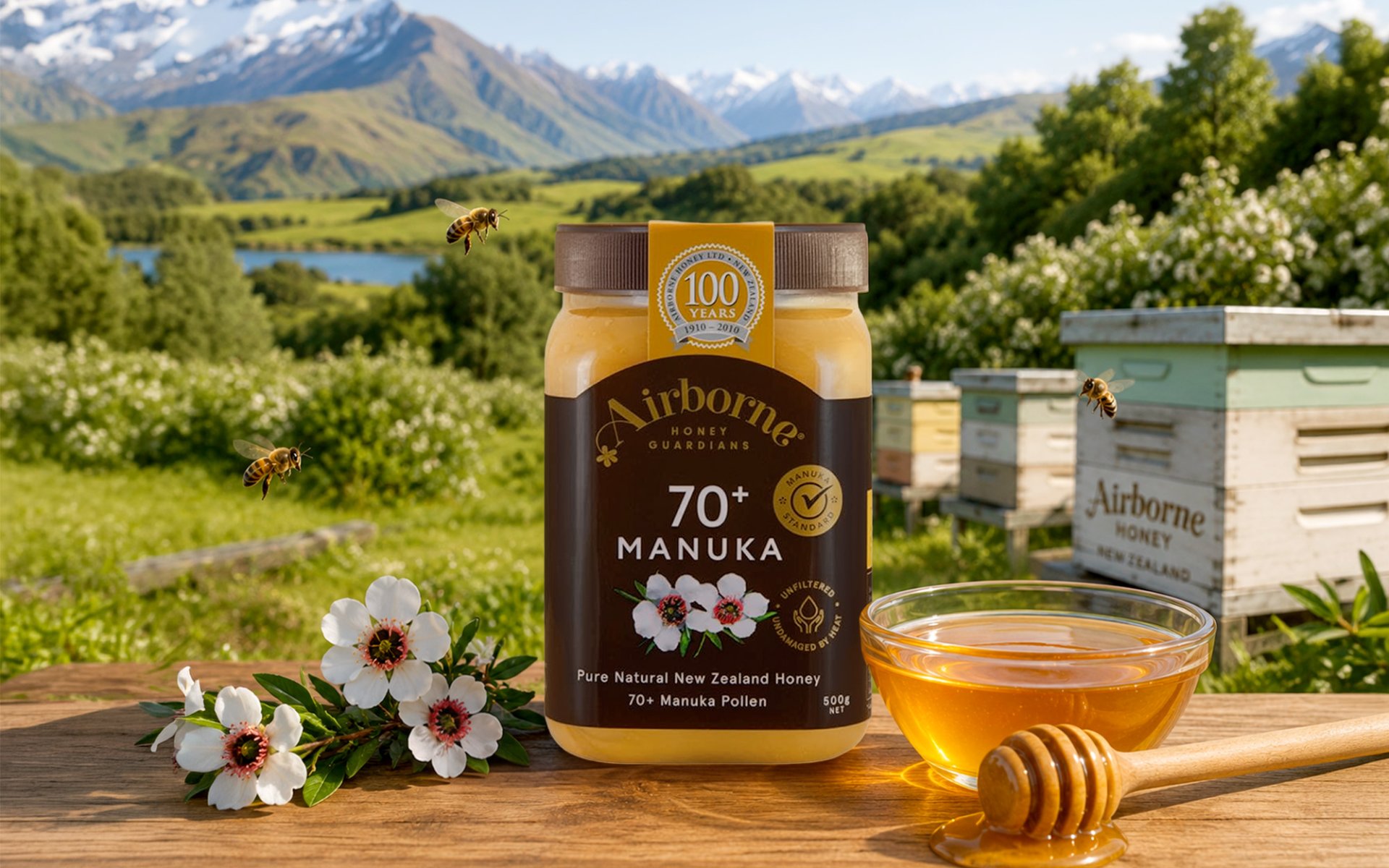
Mānuka Honey: Airborne’s world-renowned Mānuka Honey is carefully authenticated using New Zealand’s official five-factor testing standard, which includes four naturally occurring chemical markers and one DNA marker from Mānuka pollen. Each product is classified as either Monofloral or Multifloral Mānuka Honey and clearly labeled with its MGO rating, such as MGO 300+.
Creamed Clover Honey: One of Airborne’s signature products, Creamed Clover Honey is made from White Clover nectar and slowly churned over several days to create an exceptionally smooth, velvety texture. The result is a honey that resists coarse crystallization while offering delicate notes reminiscent of vanilla and butter.
Rātā Honey: Prized for its delicate sweetness.
Rewarewa Honey: Known for its rich malt-like flavor.
Honeydew Honey: A dark honey harvested from New Zealand’s native beech forests.
Since the 1990s, Airborne has expanded its exports to numerous international markets, including China, Japan, Singapore, the United States, the Middle East, and Thailand. Its products have earned a strong reputation within the premium honey market thanks to their exceptional purity, distinctive floral characteristics, rigorous quality control, and comprehensive laboratory certification.